
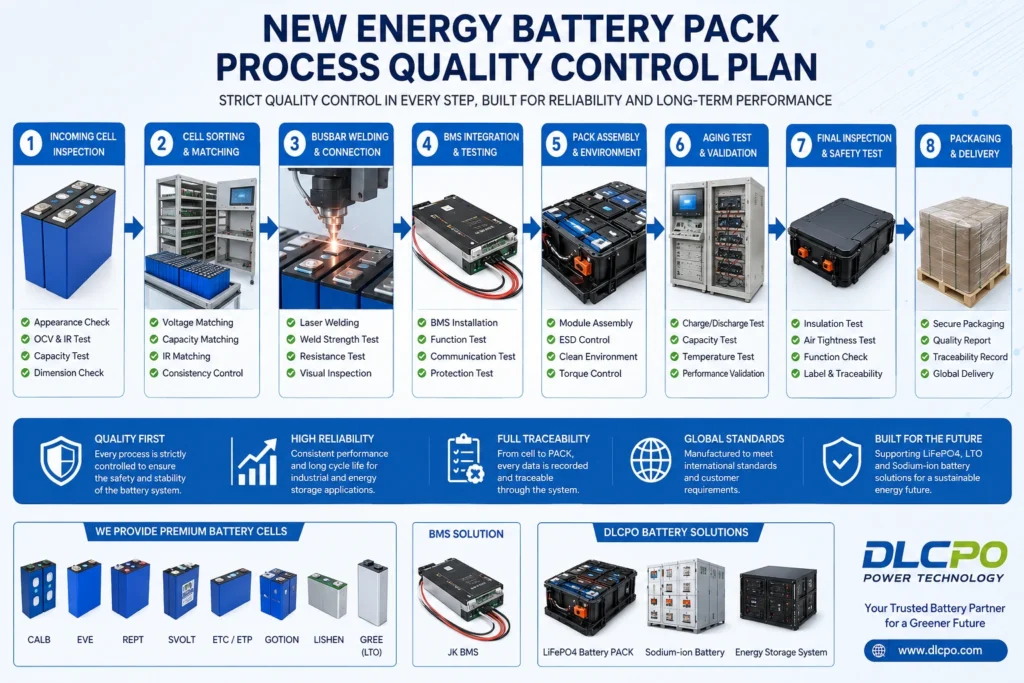
Executive Summary: Implementing a rigorous battery pack process control plan is the only way to prevent early voltage drift in energy storage systems.Not long ago, an energy storage integrator in Germany asked us a question that sounded simple but cut straight to the core of what we do: “We use the same CALB LFP cells as another project, yet our packs start showing voltage drift after about 800 cycles. What are we missing?” The answer didn’t live in the cell datasheets. It lived in the space between cell arrival and final pack shipment — a space where inconsistent busbar torque, skipped aging steps, or a poorly calibrated BMS can quietly undo months of careful design work.
That conversation, and a dozen like it, is why DLCPO Power Technology Co. decided to stop treating quality control as a checklist and start treating it as a living framework. Over the years, we’ve shaped a seven-stage process that spans everything from incoming cell inspection to end-of-line aging — and along the way, we’ve discovered that some of the most important quality levers are the ones almost nobody talks about at trade shows.
If you’re an industrial equipment builder, a LiFePO4 battery wholesaler, or anyone whose reputation depends on a pack that delivers consistent cycle life, I’ll walk you through exactly what that framework looks like — the numbers we watch, the mistakes we’ve learned from, and the standards that are finally catching up to what disciplined manufacturers already do.
The Uncomfortable Truth: Great Cells Don’t Automatically Make Great Packs
Walk through any battery expo and you’ll hear impressive claims about energy density, cycle life, and 1C continuous discharge. What you rarely hear discussed in detail is batch consistency variance — the reality that two batches of LiFePO4 cells from the same Tier-1 manufacturer, with the same model number, can arrive at your dock with subtle but meaningful differences in open-circuit voltage, internal resistance, and capacity distribution.
I’ve personally reviewed incoming inspection reports where a shipment of REPT 280Ah cells showed a voltage spread of just 4 mV across the batch while a separate lot of GOTION cells, nominally identical, spanned 9 mV. Neither batch was “bad.” But if you were assembling packs without sorting them into tight performance neighborhoods, the wider-spread batch would inevitably start showing voltage divergence earlier in its service life — particularly in high-temperature installations where imbalance accelerates.
That’s why the very first stage of our quality control plan, incoming quality control (IQC), isn’t a box-ticking exercise. Every arriving cell lot gets a full parameter sweep: open-circuit voltage, AC internal resistance at 1 kHz, and capacity sampling. Cells falling outside a ±3 mV window for LFP or a ±2 mV window for LTO are flagged and held for detailed re-evaluation. We also track the K-value (self-discharge rate), targeting a maximum of 0.05 mV/day for cells destined for packs that need to sit idle for periods without active balancing.
What’s made this early-stage rigor unexpectedly powerful is something we originally introduced for an entirely different reason: our “No Stock” policy. Every customer order triggers a fresh production allocation from the manufacturer — CALB, EVE, SVOLT, GOTION, LISHEN, or whichever partner the client’s specification requires — which means every cell that reaches our assembly area has uniform calendar age. Cells that have been sitting on a warehouse shelf for three months develop slightly different surface chemistry than freshly produced ones, and while the difference is small, it adds a variable that no amount of downstream matching can fully erase. The “No Stock” approach wasn’t designed as a quality measure, but over the course of hundreds of pack builds, it’s proved to be one of the quietest batch-consistency controls in our toolkit.
Stage by Stage: Where Quality Is Actually Built (or Lost)
Moving from theory to the assembly floor, our PACK process control plan spans seven distinct stages, each with defined control points, measurement tolerances, and — critically — a clear reaction plan for when something drifts out of spec. Borrowing principles from automotive PFMEA methodology, here’s how we structure it.
1. Cell Sorting & Grading
Sorting is where we transform a batch of “good” cells into a set that’s genuinely uniform. Automated equipment measures voltage, capacity, and internal resistance and assigns each cell to a performance bin. For LiFePO4 prismatic cells, we typically work within a voltage band of 3,275–3,305 mV. Why so tight? Because even a 10 mV difference at the start of life can translate into a measurable state-of-charge gap after several hundred partial-state-of-charge cycles — exactly the kind of operational profile common in solar storage applications. Cells outside the band are downgraded or rejected outright.
2. Cell Matching & Grouping
Grading puts cells into bins, but matching goes further: it groups cells from the same bin into parallel and series blocks where the differences between them are vanishingly small. We target a capacity deviation below 0.5% within any parallel group. This isn’t excessive precision for its own sake. We’ve analyzed 48V ESS modules after 500 cycles and found that packs built with <0.5% group deviation maintained cell voltage spread under 30 mV, while packs with looser matching drifted past 80 mV — a gap that forces the BMS to work harder and shortens effective runtime.
3. Busbar Welding & Electrical Connections
Here the quality plan shifts from electrical parameters to physical ones. Laser welding dominates modern assembly for good reason — it offers low and stable contact resistance, minimal heat-affected zone, and repeatable penetration depth. But good equipment doesn’t guarantee good welds; parameter control does. We monitor weld pull force, nugget consistency, and surface oxidation on sample coupons every shift. CCD visual inspection systems scan finished welds for micro-cracks or porosity, and every joint is verified for contact resistance at ≤0.1 mΩ. A single high-resistance busbar connection in a 100A discharge pack can concentrate current and create a hotspot that degrades adjacent cells over time. You won’t see the damage on day one, but by month six, the imbalance tells the story.
For a closer look at how connection design choices ripple through module performance, our article on LiFePO4 battery module electrical connection design goes deeper.
4. BMS Integration & Functional Verification
Even the most meticulously matched cells can be undermined by a poorly integrated BMS. The JK BMS units we deploy in industrial packs need to do more than monitor voltage and current — they must communicate cleanly with inverters over CAN or RS485, trigger protection functions within specified time windows, and manage sleep/wake cycles without introducing unintended parasitic drain. Our functional testing simulates overcurrent, short-circuit, and cell undervoltage conditions to confirm that the protection cascade works as designed. In our experience, many field issues reported as “battery failure” are actually communication mismatches or calibration drift between the BMS and external equipment — problems that a rigorous functional test can catch before the pack leaves the factory.
5. Assembly Environment & ESD Control
This is a stage that rarely gets headline attention but routinely separates professional pack builders from hobbyists. Lithium battery assembly demands strict environmental control: humidity below 60% RH, positive air pressure to limit dust ingress, and comprehensive ESD protection. Static discharge can damage BMS components invisibly, creating latent failures that surface weeks or months later. Our workshop uses ESD flooring, continuous wrist-strap monitoring, and ionizing fans at sensitive stations. We also enforce a metal-particle management protocol — a precaution that sounds extreme until you’ve seen what a single stray copper strand can do inside a high-voltage cabinet.
6. Final PACK Assembly & Enclosure
Multiple modules come together inside the final enclosure alongside contactors, fuses, and thermal management hardware. Every high-voltage connection is torque-verified a second time with calibrated digital wrenches; for structural fasteners, we log each value at 15 N·m. Undershoot that number and vibration will eventually loosen the joint; overshoot and you risk deforming a cell casing. A torque log filled with consistent 15 N·m entries across an entire production batch is one of the quietest signals of a line that’s running under control.
7. End-of-Line Testing & Aging
The final gate before shipment combines a full charge-discharge cycle at 0.5C with continuous cell-level monitoring, followed by a minimum 72-hour aging period where we track open-circuit voltage decay. A pack that passes functional tests but shows accelerated self-discharge during aging almost certainly harbors a latent cell defect — something that even the tightest incoming inspection can occasionally miss. For packs destined for remote telecom or mining sites where a service visit costs more than the battery itself, this aging step is non-negotiable.
Why Standards Like GB/T 47292.4-2026 Are Finally Closing the Gap
China’s newly released GB/T 47292.4-2026 (Lithium Ion Battery Good Manufacturing Practice — Part 4: Battery Pack Process Control and Finished Product Testing) addresses something the industry has needed for years: a unified framework that treats the entire pack assembly chain as a quality-managed process. The standard mandates 100% testing on key parameters, full data traceability, and quantifiable targets for defect rates and process capability across seven critical areas — from ESD protection and technical cleanliness to welding quality and finished-product testing.
What’s significant here isn’t just the scope but the tiered A/B/C classification. It forces integrators to measure themselves against something more objective than their own marketing. We’ve aligned our internal control limits with Level A requirements, and in several areas — like the granularity of traceability data we link to each cell’s original manufacturer QR code — we go further, because our industrial customers increasingly need that documentation for their own compliance audits at ports, project sites, and insurance inspections.
The Chemistry-Specific Twist: LTO, Sodium-Ion, and the Danger of One-Size-Fits-All QC
Not all battery chemistries respond the same way to the same process parameters, and we’ve learned to adapt our plan accordingly. GREE’s lithium titanate (LTO) cells, for instance, operate at a nominal 2.3V — a voltage range where small absolute variations represent larger relative state-of-charge differences. We tighten the incoming voltage tolerance for LTO to ±2 mV and add a rate-capability pulse test, because LTO’s primary value proposition (20,000+ cycles at 10C–20C charge rates) leaves no margin for early-stage inconsistency.
Our own DLCPO-brand sodium-ion cells introduce a different set of considerations. Sodium-ion chemistry operates over a wider voltage window than LFP, so we’ve recalibrated sorting windows to ±4 mV and extended the aging protocol to 96 hours, reflecting the different stabilization behavior we’ve observed during early-cycle formation. If you’re exploring how sodium-ion fits into larger energy storage architectures, our 2026 Sodium-Ion Battery Energy Storage piece covers the trade-offs.
What’s consistent across chemistries is the principle: the quality control plan has to be built around the chemistry’s actual behavior, not a generic template. For readers weighing different technologies, the 2026 Battery Technology Roadmap maps out how LFP, LTO, and sodium-ion each earn their place in the supply chain.
What This Means for Battery Buyers and Wholesalers
If you’re sourcing LiFePO4 packs for industrial vehicles, containerized storage, or backup systems, the single most useful request you can make of a supplier isn’t for a cycle-life graph — it’s for a copy of their process control plan. Look for concrete numbers (torque values, voltage windows, resistance thresholds), not adjectives. Ask what happens when a measurement falls out of spec. A supplier who can show you a reaction plan — isolation, root cause analysis, corrective action — is revealing something far more valuable than a spec sheet: they’re showing you their manufacturing culture.
At DLCPO Power Technology, we’ve built our reputation on making that culture visible. Whether we’re supplying CALB, EVE, REPT, SVOLT, GOTION, LISHEN, GANFENG, or GREATPOWER LFP cells, GREE LTO cells, our own sodium-ion packs, or JK BMS-integrated systems, the process discipline behind every build is the same. It’s not always glamorous work, but it’s what keeps packs balanced, buyers confident, and service calls rare.
Frequently Asked Questions
1. What’s the difference between cell sorting and cell matching, and why do both matter?
Sorting classifies cells into bins based on voltage, capacity, and internal resistance. Matching groups cells from the same bin into parallel and series arrangements, minimizing the differences between cells in that group. Skipping rigorous matching means even “sorted” cells can still create imbalance, especially in high-cycle-count applications.
2. How does DLCPO’s “No Stock” policy contribute to pack quality?
Every order triggers a fresh production allocation rather than drawing from warehoused inventory. This eliminates calendar-aging variance — a subtle variable where cells stored for months behave slightly differently from freshly produced ones, even if both meet specification. Starting with uniformly young cells improves long-term pack balance.
3. What are the most common quality failures in battery pack welding?
Inconsistent penetration, surface oxidation at the weld interface, and micro-crack formation are the usual culprits. Even a small increase in contact resistance at a single busbar joint can generate localized heating during discharge, accelerating degradation in adjacent cells over time.
4. Why do LTO and sodium-ion batteries need different QC parameters than LFP?
LTO’s low nominal voltage means that small absolute voltage deviations represent larger relative state-of-charge gaps, demanding tighter sorting tolerances. Sodium-ion operates over a wider voltage window and exhibits different early-cycle stabilization, requiring adjusted grading windows and longer aging protocols. A single set of QC limits across all chemistries is a sign of inexperience.
5. Does DLCPO provide traceability documentation for end-customer audits?
Yes. Every pack ships with a traceability report linking cell-level QR codes to sorting data, assembly records, welding inspection logs, and EOL test results. This documentation package is standard for all industrial and ESS orders, supporting compliance audits and site acceptance procedures.
⚠️ Important Technical Disclaimer
The information provided in this article by DLCPO Power Technology Co., Ltd. is intended for general informational and educational purposes only. While we strive to ensure the accuracy of technical data regarding LiFePO4, LTO, and other battery chemistries, industry standards and product specifications are subject to continuous R&D updates.
Please note that actual battery performance—including cycle life, charging speeds, and thermal stability—is heavily dependent on specific real-world application parameters, environmental conditions, and the proper integration of a Battery Management System (BMS). The data presented does not constitute a binding performance guarantee.
DLCPO assumes no liability for any direct, indirect, or incidental damages arising from the use or misinterpretation of this content. For project-specific engineering advice, official datasheets, and verified Grade-A cell procurement, please contact our technical sales team directly at dlcpo@dlcpo.com.


