
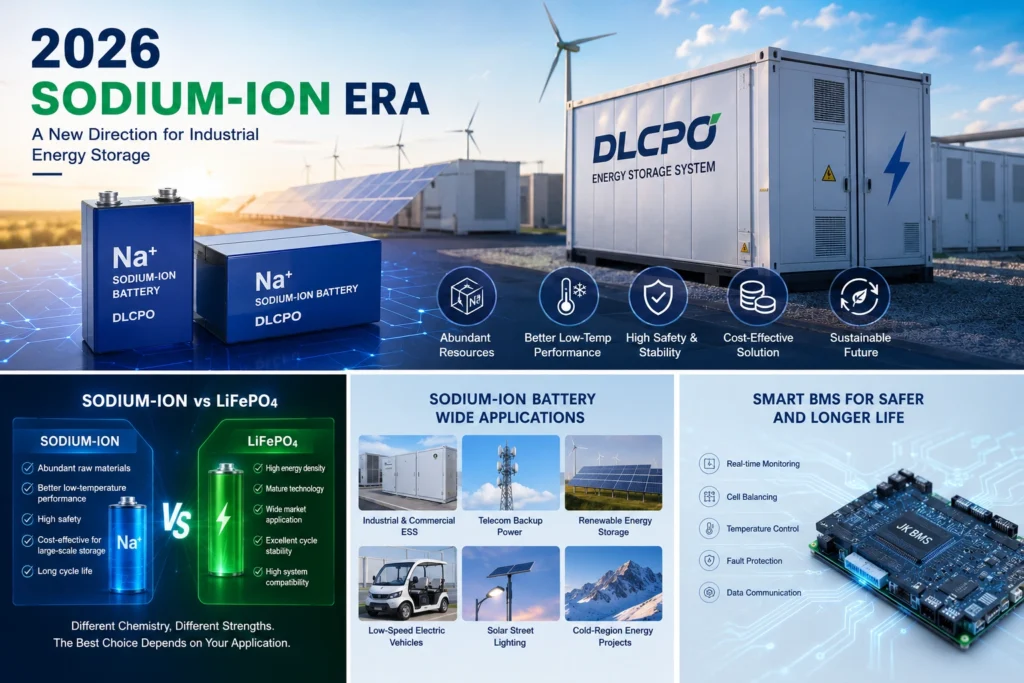

For more than a decade, the global battery industry has revolved around lithium—and for good reason. From electric vehicles to renewable energy storage systems, lithium-ion chemistry built the foundation of modern electrification. But by 2026, the conversations happening across procurement departments, engineering firms, and distributor networks have shifted in a way that would have been hard to imagine even three years ago. Nobody is asking whether sodium-ion batteries are viable anymore. The sodium-ion battery 2026 inflection point is here—and the real question is how quickly companies can get them into the field.
This change didn’t arrive as a sudden disruption. It crept in through supply chain anxieties, raw material price swings, and a growing recognition that safer, more thermally stable storage systems deserve a bigger seat at the table. What’s different about 2026 is that sodium-ion technology has crossed from “interesting alternative” into “commercially practical solution”—and the market evidence is now impossible to ignore.
At DLCPO Power Technology, our conversations with overseas battery wholesalers and energy storage integrators throughout the past year revealed a consistent pattern: industrial buyers are no longer chasing energy density as their sole procurement metric. They want cost stability, supply chain resilience, safety, and long-cycle reliability. That shift in priorities is exactly what the sodium-ion battery 2026 breakthrough was designed to address.

Why 2026 Is the Sodium-Ion Battery Inflection Point
When CATL and energy storage integrator HyperStrong signed a three-year, 60 GWh sodium-ion supply agreement in April, the industry took notice in a way that no white paper ever achieved. This wasn’t a memorandum of understanding or a pilot program—it was the largest sodium-ion battery order ever placed, backed by a concrete delivery timeline. The storage-dedicated cell CATL unveiled just days earlier, exceeding 300 Ah with a claimed cycle life beyond 15,000 cycles, made it clear this wasn’t a repurposed EV design wearing a new label.
MIT Technology Review placed sodium-ion batteries on its 2026 list of breakthrough technologies, noting that CATL had solved the core manufacturing challenges around moisture control and hard carbon outgassing that previously constrained production yields. The assessment was measured but unambiguous: sodium-ion “is finally making its way into cars—and the grid.”
What’s striking about 2026 isn’t simply the volume of announcements. It’s the segmentation that’s emerging across the supply base. BYD has anchored its sodium-ion strategy firmly in stationary storage, targeting 20,000 cycles with polyanion-based chemistry, and already operates the world’s first megawatt-scale sodium-ion storage system—deployed back in 2025 and accumulating operational data ever since. HiNa Battery, backed by the Chinese Academy of Sciences, is carving out heavy-duty niches in mining trucks and frigid-environment logistics, with plans to deliver roughly 200 vehicles in 2026 and hundreds more on order. CATL is pursuing the broadest play: passenger EVs, battery swapping, and grid-scale storage simultaneously.
When the market begins differentiating—when companies pursue distinct strategies rather than copying each other—that’s a reliable sign of maturation, not fragmentation. It signals that sodium-ion is evolving into a genuine product category with its own performance characteristics and application sweet spots, not merely a lithium substitute that happens to be cheaper.
Sodium itself is one of the most abundant elements on Earth. Its supply chain is geographically diversified in ways that lithium’s simply isn’t, and for industrial buyers managing multi-year procurement risk, that structural advantage matters more than many market forecasts initially assumed. The raw material economics are beginning to catch up, too: in January 2026, Zhongna Energy brought online the world’s first 10,000-ton sodium iron sulfate cathode material facility in Meishan, Sichuan—a milestone expected to drive cathode material costs to roughly half that of lithium iron phosphate equivalents. When upstream material prices drop by 50%, cell-level costs follow, even if the timeline isn’t immediate.
Where Sodium-Ion Is Winning—On Merit, Not Just Price
Lithium iron phosphate batteries remain the dominant chemistry for residential ESS, telecom backup, and commercial solar—and they’ll hold that position for years to come. Our own Grade A LiFePO4 cell inventory, sourced fresh from CALB, EVE, REPT, SVOLT, Gotion, Lishen, Ganfeng, Great Power, and Higee under a strict order-specific production policy, continues to be the backbone of most customer procurement. But sodium-ion is carving out advantages in three areas where LFP has always had to compromise.
The first is low-temperature performance. The International Energy Agency’s early-2026 analysis noted that sodium-ion batteries can retain approximately 90% of nominal capacity at -20°C—a figure that aligns closely with field data emerging from Asian and European integrator trials conducted during 2025. Traditional lithium systems in cold climates often require auxiliary heating infrastructure that adds cost, complexity, and parasitic load. Sodium-ion sidesteps much of that, which is why it’s gaining traction in telecom backup for northern latitudes, off-grid systems at high altitudes, and any application where heating a battery enclosure is impractical. CATL’s energy-storage-dedicated cell also claims a 97% round-trip efficiency, putting it on par with mainstream LFP for daily cycling.
The second is thermal safety. Large industrial ESS installations are increasingly prioritizing fire propagation risk in their procurement criteria, and sodium-ion chemistry naturally operates with lower thermal runaway sensitivity under conditions that would stress lithium systems. For utility-scale backup, communication infrastructure, and decentralized microgrid projects—especially those installed near populated areas or critical assets—that safety margin translates directly into lower insurance costs and simpler site engineering.
The third advantage is harder to quantify but increasingly important: supply chain confidence. Buyers who lived through the lithium price volatility of 2021–2023 remember the experience vividly. Sodium-ion offers a procurement path that’s less coupled to a single concentrated mining geography, and for long-term infrastructure planning, that diversification has independent value regardless of per-kilowatt-hour comparisons.
None of this means sodium-ion will replace LFP across the board. The more realistic scenario—and the one most battery professionals now anticipate—is coexistence across a multi-chemistry landscape. Energy density remains sodium-ion’s primary constraint: CATL’s second-generation cells reach 175 Wh/kg, edging closer to LFP territory but still trailing the 200+ Wh/kg that premium LFP cells routinely deliver. And while cycle life claims of 15,000 to 20,000 cycles are impressive on paper, LFP has accumulated over a decade of field performance data that banks and insurers trust when underwriting project financing. That data gap matters for bankability, and it’s one reason we continue to recommend that clients evaluate procurement decisions against the full picture: application requirements, ambient conditions, financing constraints, and total cost of ownership rather than upfront cell price alone.
The Real Opportunity: Industrial and Commercial Energy Storage
Consumer electronics once drove battery innovation forward. Today, large-scale storage economics are pulling the industry in new directions—and that environment strongly favors sodium-ion adoption across several sectors where the technology’s specific strengths align with operational priorities.
Factories, telecom operators, renewable developers, and off-grid infrastructure providers evaluate batteries on a different set of criteria than EV engineers do. They care about lifecycle predictability, maintenance burden, transportation safety, and long-term supply continuity. Energy density is on the list, but it’s rarely at the top. What makes the 2026 market especially interesting is that buyers are no longer viewing sodium-ion as a “budget option.” Increasingly, they see it as a strategic complement to lithium systems—a way to match specific chemistries to specific operational windows rather than forcing one technology to serve every need.
Hybrid ESS projects combining LiFePO4 and sodium-ion modules are beginning to appear in pilot deployments. In these configurations, sodium batteries handle cost-sensitive backup storage or low-temperature discharge duty, while lithium systems manage the high-density cycling requirements. That kind of practical engineering integration—designing systems around the strengths of multiple chemistries rather than treating one as primary and the other as backup—often signals that a technology is approaching commercial maturity. The most visible applications where sodium-ion is gaining ground include commercial and industrial ESS cabinets, telecom backup power, low-speed electric mobility, solar street lighting, distributed renewable storage, data center auxiliary backup, and cold-region energy projects that would otherwise require expensive thermal management for lithium systems.
For applications demanding even more extreme low-temperature resilience, our GREE lithium titanate (LTO) batteries—operating to -40°C with exceptional cycle durability—remain a proven solution. Sodium-ion now offers a complementary path: similar cold-weather capability at a more accessible price point, with slightly different trade-offs in energy density and cycle life. The battery market in 2026 has definitively become a multi-chemistry landscape, and the smartest procurement strategies are the ones that acknowledge it.
How Chinese Manufacturing Infrastructure Is Accelerating Commercialization
China’s battery ecosystem continues to lead global production scaling, and sodium-ion technology is benefiting directly from manufacturing infrastructure that was originally built for lithium. Several established battery companies have expanded research investment into sodium chemistry while simultaneously improving material processing efficiency and pack integration design—a combination that has produced a much faster commercialization cycle than most analysts expected earlier in the decade.
As a professional battery supplier focused on international industrial markets, DLCPO Power Technology works closely with multiple battery brands and system partners across the LiFePO4, LTO, and sodium-ion sectors. This diversified cooperation model allows overseas customers to compare technologies based on real project requirements rather than marketing narratives. Companies sourcing industrial battery cells in 2026 are increasingly requesting stable long-term supply capability, consistent cell batch quality, flexible OEM/ODM support, technical compatibility with advanced BMS architectures, proven international shipping experience, and multi-chemistry sourcing options from a single supplier. That last requirement—multi-chemistry capability—is becoming particularly important as integrators design systems that may combine different cell types for different operational functions.
This is one reason integrated battery solution providers are gaining ground over single-product vendors. Customers planning future ESS projects often explore multiple chemistries simultaneously before finalizing procurement decisions, and a supplier who can provide LFP today, help prototype sodium-ion for tomorrow, and offer LTO when the application demands it brings practical value that a specialized vendor simply can’t match. Our own DLCPO NFPP 170Ah sodium-ion cells, built on the NFPP cathode platform, offer a no-compromise entry point for industrial storage integrators who want to begin qualifying sodium-ion battery 2026 technology for their product roadmaps without waiting for lead times from the major manufacturers.
BMS Technology: The Overlooked Piece of the Sodium-Ion Puzzle
Battery chemistry alone doesn’t determine system performance—a point that’s easy to overlook amid the excitement around new cell technologies. As sodium-ion deployments grow, battery management systems become equally critical in ensuring long-term reliability and operational safety. Intelligent cell balancing, multi-point temperature monitoring, and seamless communication integration directly affect battery lifespan and field stability, and the demands sodium-ion places on BMS architectures aren’t identical to those of lithium systems.
This is why many industrial integrators now prioritize compatibility between battery cells and advanced BMS platforms during procurement evaluation. A well-designed BMS can extend usable life, prevent cascading failures, and provide the diagnostic data that operators need for predictive maintenance. At DLCPO, we supply integrated battery solutions alongside JK BMS systems to help overseas partners simplify ESS integration workflows and improve system-level control efficiency—whether the project uses LFP, sodium-ion, LTO, or a combination of chemistries.
Looking Beyond the Sodium-Ion Battery 2026 Landscape
Battery transitions rarely follow a straight line, and the global market will remain multi-chemistry for the foreseeable future. Yet sodium-ion batteries have decisively left the laboratory. Commercial deployments are expanding, industrial buyers are actively qualifying systems, and supply chains are scaling at a pace that surprises even close observers of the industry.
What makes the sodium-ion battery 2026 moment so significant isn’t technological progress alone—it’s market confidence. The energy storage industry has entered a phase where diversification matters as much as innovation. Buyers want resilience. Integrators want flexibility. Regulators and insurers want safer infrastructure. Sodium-ion chemistry aligns with all three priorities in ways that few other technologies can claim.
For industrial users and battery wholesalers evaluating future storage strategies, the question is no longer whether sodium-ion deserves attention. The real question is how quickly companies can position themselves before adoption accelerates further—and whether they have a supply partner capable of supporting them across the full chemistry spectrum that 2026 now demands.
At DLCPO Power Technology, we built our sourcing strategy around this multi-chemistry reality because we saw it coming. Whether your next project requires premium LFP cells from tier-1 manufacturers, sodium-ion cells for cold-climate storage, or LTO batteries for extreme-duty applications, we’re positioned to deliver—with the technical guidance to help you match the right chemistry to the right application.
FAQ
Q: Are sodium-ion batteries ready to replace LiFePO4 batteries across the board?
Not as a wholesale replacement, and likely not for years to come. Sodium-ion excels in stationary storage, cold-climate applications, and cost-sensitive projects where energy density is not the primary constraint. LiFePO4 still offers higher demonstrated cycle life backed by over a decade of field data, better energy density, and deeper project financing track records. The two chemistries are better understood as complements—each serving different operational priorities—rather than direct competitors. DLCPO supplies both and helps customers match the technology to the specific use case.
Q: What are the primary applications where sodium-ion batteries are gaining traction in 2026?
The strongest adoption is occurring in commercial and industrial ESS systems, telecom backup power for cold regions, low-speed electric mobility, solar street lighting, distributed renewable storage, data center auxiliary backup, and off-grid installations at high latitudes or altitudes. Any application where low-temperature performance, thermal safety, or supply chain stability matters more than maximizing energy density is a candidate for sodium-ion evaluation.
Q: How does DLCPO ensure consistent quality across both sodium-ion and LFP cell sourcing?
Our DLCPO-brand sodium-ion cells are built on the NFPP cathode platform, with manufacturing partners meeting the same rigorous traceability and testing standards we apply to the Grade A LFP cells we source from CALB, EVE, REPT, SVOLT, Gotion, Lishen, Ganfeng, Great Power, and Higee. We maintain a strict no-stock, order-specific production policy across all chemistries—every cell, whether LFP, LTO, or sodium-ion, is freshly produced and verified per customer order with full QR code traceability.
Q: Will sodium-ion battery costs eventually undercut LFP pricing?
Most industry projections suggest sodium-ion costs could approach parity with LFP by 2027–2028 as production scales and upstream material facilities (such as Zhongna Energy’s 10,000-ton cathode plant in Sichuan) drive input costs lower. At the cell level, sodium-ion still carries a premium in 2026, but the gap is narrowing faster than many forecasts anticipated. For projects where upfront capital expenditure dominates the business case, sodium-ion is already competitive on a system-level basis in certain configurations.
Q: Can I source LFP, sodium-ion, and LTO cells from a single supplier?
Yes. DLCPO Power Technology supplies premium LFP cells from multiple tier-1 manufacturers, our own DLCPO-brand sodium-ion cells, and GREE LTO batteries for extreme-temperature applications. For integrators building multi-chemistry systems or evaluating sodium-ion technology alongside existing LFP procurement, we can consolidate shipments, provide cross-chemistry engineering support, and help match the right cell to each operational requirement. Contact us to discuss your specific project needs.
⚠️ Important Technical Disclaimer
The information provided in this article by DLCPO Power Technology Co., Ltd. is intended for general informational and educational purposes only. While we strive to ensure the accuracy of technical data regarding LiFePO4, LTO, and other battery chemistries, industry standards and product specifications are subject to continuous R&D updates.
Please note that actual battery performance—including cycle life, charging speeds, and thermal stability—is heavily dependent on specific real-world application parameters, environmental conditions, and the proper integration of a Battery Management System (BMS). The data presented does not constitute a binding performance guarantee.
DLCPO assumes no liability for any direct, indirect, or incidental damages arising from the use or misinterpretation of this content. For project-specific engineering advice, official datasheets, and verified Grade-A cell procurement, please contact our technical sales team directly at dlcpo@dlcpo.com.


