
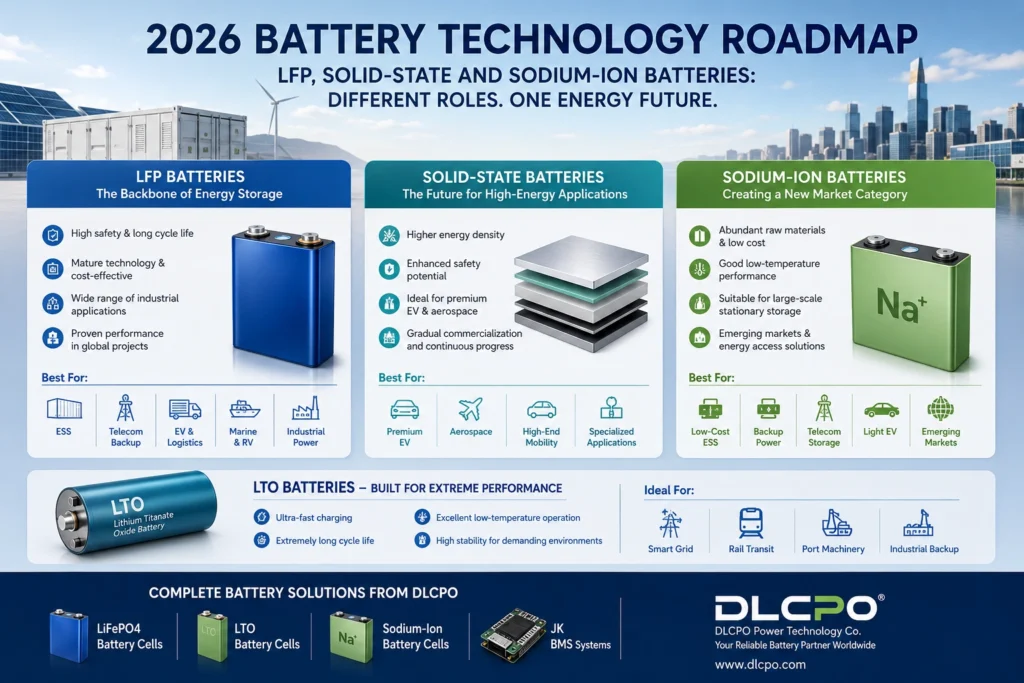

A practical look at how LFP, solid-state, sodium-ion, and LTO are carving their own roles — and why industrial buyers are choosing DLCPO as a multi-chemistry partner.
That change in mindset reflects something important about the energy storage market. It has grown too large, too specialized, for a single technology to cover everything. And while headlines still chase breakthroughs, the daily work of procurement — the orders we process for CALB, EVE, REPT, SVOLT, ETC, ETP, GOTION, LISHEN, GANFENG, GREATPOWER, HIGEE LFP cells, GREE lithium titanate batteries, DLCPO sodium-ion cells, and JK BMS units — tells a far more grounded story. Three chemistries, plus one niche veteran, are each carving out a real commercial position. Let’s walk through what that means for your supply chain in 2026.
LFP: The Dependable Foundation That Keeps Growing
Lithium iron phosphate isn’t the “budget option” anymore — if it ever was. In many large-scale storage and industrial projects, LFP has become the default choice because its lifecycle economics simply work. Cycle life routinely surpasses 4,000–6,000 cycles at 80% depth of discharge, thermal stability is proven across millions of installations, and the manufacturing base in China has reached a level of automation and consistency that’s hard to replicate. Our daily interactions confirm this: inquiries for large-format prismatic cells in the 280 Ah to 314 Ah range grew roughly 40% year-on-year in early 2025, driven by containerized ESS, C&I storage, and off-grid solar demand.
There’s another piece often overlooked in spec sheets. Many industrial buyers — forklift manufacturers, AGV fleet operators, telecom infrastructure teams — have quietly walked away from lead-acid and even some NMC packs, not because of a sustainability pledge, but because maintenance savings alone can justify the switch in under 18 months. A food logistics company we worked with replaced its entire lead-acid fleet with EVE 304 Ah cells paired with a carefully configured BMS; the reduction in watering, equalizing charges, and unplanned downtime paid for the project faster than their own finance team predicted. If you’re evaluating cells for similar motive power or storage applications, our current LFP cell lineup covers factory-fresh stock from all the major producers mentioned above.
So why, then, do conversations still drift toward the “next big thing”? Solid-state is the obvious one, but the answer is less about LFP losing ground and more about new market segments opening up.
Solid-State: Progress Is Real, But Deployment Is Selective
Solid-state batteries have earned every bit of attention they receive. The core idea — replacing liquid electrolyte with a solid conductor to push energy density beyond 400 Wh/kg while dramatically improving safety — is genuinely compelling. In 2026, however, what’s commercially available is far more nuanced than the broad label suggests. Semi-solid, hybrid-electrolyte, and true all-solid-state systems are all at different stages, and the gap between lab results and factory-door economics remains significant.
I recall a test one of our engineers ran late last year with a semi-solid-state sample from a well-regarded innovator. The discharge performance at -30°C was impressive, easily outperforming conventional LFP. But when we applied realistic load profiles over several hundred cycles, capacity faded to under 1,500 cycles — a non-starter for most stationary storage projects. That doesn’t diminish the technology’s potential; it just clarifies where it fits in 2026. Solid-state is gaining ground fastest in weight-sensitive applications — drones, high-altitude equipment, premium EVs — where a 70% cost premium for a 20% energy density gain can be absorbed by the value of lighter weight or extended range. For industrial energy storage buyers managing 24/7 operations, that equation rarely closes today.
The more practical question isn’t whether solid-state will arrive, but where it will land first. Most battery engineers we speak with expect semi-solid variants to integrate gradually into existing lithium-ion production lines before all-solid-state reaches volume. That points to an evolution, not a sudden replacement.
Sodium-Ion: Creating Its Own Space, Not Chasing LFP
If solid-state is the high-end frontier, sodium-ion is the pragmatic newcomer that’s growing faster than many expected. A few years ago, sodium-ion cells were a lab curiosity with low energy density and questionable cycling. That’s changed. Our own DLCPO-branded sodium-ion cells, which we began sampling in mid-2025 after a year of internal evaluation, now deliver 120–145 Wh/kg, maintain over 3,000 cycles at 100% DoD in testing, and — importantly — charge reliably at -20°C without the capacity collapse you’d see in LFP.
What’s driving commercial interest isn’t just the abundance of sodium or relief from lithium price volatility, though that’s part of it. The real catalyst is that sodium-ion is creating its own market category rather than competing head-to-head with LFP in all applications. A Swedish startup we supply builds compact battery packs for e-rickshaws in South Asia; sodium-ion solved a cold-weather reliability problem that had frustrated their LFP-based units. A North American telecom backup distributor is now testing sodium-ion to cut per-site battery cost while eliminating lead-acid from their supply chain entirely. These aren’t hypotheticals — they’re orders we’re shipping. For specifications and sample requests, our DLCPO sodium-ion cell page has the details.
One operational note worth mentioning: sodium-ion’s voltage window is different — typically 2.0–3.95 V — so a standard LFP BMS won’t work without reconfiguration. Pairing these cells with a flexible system like the JK BMS units we supply can simplify integration significantly. Getting that part wrong has tripped up more than a few early adopters, which is why we spend time on BMS compatibility as part of our pre-sales support.
LTO: The Niche Veteran That Still Punches Above Its Weight
Not every demanding industrial application can be satisfied by LFP or sodium-ion alone, and that’s where lithium titanate oxide (LTO) remains quietly indispensable. LTO cells — such as the GREE batteries we distribute — offer ultra-fast charging, exceptionally long cycle life often exceeding 20,000 cycles, and stable operation in extreme cold. They’re not chasing the lowest cost per kWh; they’re solving problems where downtime isn’t an option.
In smart grid frequency regulation, port machinery, rail transit, and heavy industrial backup systems, LTO’s ability to absorb high charge rates without degrading makes it uniquely valuable. A port equipment retrofit we consulted on last year needed a battery that could handle fast opportunity charging between shifts without active cooling. LTO was the only chemistry that met the cycle-life requirement within the physical space constraints. It won’t match LFP’s volume, but for the right application, LTO is still the best answer available.
What Global Buyers Are Prioritizing in 2026
Across all these technologies, we’ve noticed a shift in how overseas buyers approach procurement. Price remains important, of course, but the questions have deepened. Distributors and project developers now ask about batch consistency, factory audit reports, certification status, and long-term inventory availability before they get to unit cost. A single shipment delay or a batch with unexpected capacity drift can jeopardize an entire project timeline.
This is why multi-chemistry suppliers with direct access to tier-one Chinese cell manufacturing and global logistics infrastructure are gaining traction. Buyers increasingly want a partner who can ship container loads of REPT or SVOLT LFP cells, offer DLCPO sodium-ion samples for a parallel development track, supply GREE LTO for specialized systems, and recommend the right JK BMS configuration — without having to manage four different vendor relationships. That’s exactly the model we built DLCPO Power Technology to serve, combining a manufacturer’s product insight with a trader’s flexibility and reach.
The Road Ahead Is Layered, Not Winner-Take-All
The 2026 battery technology roadmap isn’t a championship fight. It’s a layered ecosystem where LFP continues to anchor mainstream energy storage with proven safety and lifecycle value, solid-state advances into premium mobility and high-energy niches, sodium-ion opens cost-sensitive and cold-climate segments, and LTO holds its ground in ultra-high-cycle industrial roles. The most resilient supply chains are those that recognize this diversity and build flexibility into their sourcing strategies. And for the customers we talk to every day, that understanding is already shaping their next purchase order.
FAQ
- 1. Will solid-state batteries replace LFP in stationary storage soon?
- Not at scale. Semi-solid-state cells are entering niche high-value applications, but the cost, manufacturing maturity, and long-term field data required for mass ESS deployment keep LFP firmly in place through 2026 and beyond.
- 2. Why should I consider sodium-ion if LFP already works well?
- Sodium-ion offers advantages in cold-weather charging, lower raw material dependency, and cost for applications where energy density is less critical — such as telecom backup, low-speed vehicles, and developing-market storage projects. It’s a complement to LFP, not a replacement.
- 3. What makes DLCPO different from other battery trading companies?
- We bring a manufacturer’s technical understanding — DLCPO originated as a polymer battery factory in 2007 — combined with direct supply of genuine cells from CALB, EVE, REPT, SVOLT and other top brands, plus our own sodium-ion cells and JK BMS. This gives you verified quality, multi-chemistry options, and integrated support.
- 4. Can I use the same BMS for LFP and sodium-ion batteries?
- No, the voltage windows differ. Sodium-ion typically operates between 2.0–3.95 V versus 2.5–3.65 V for LFP. A configurable BMS like the JK BMS models we distribute can be adjusted, but you must reconfigure voltage thresholds and balance settings correctly.
- 5. Which chemistry is best for fast-charging industrial applications?
- For ultra-fast charging and extreme cycle-life requirements, LTO (lithium titanate) remains the strongest candidate, especially in applications like port machinery, rail, and grid stabilization. LFP can handle moderate fast charging well, but where charge rates exceed 3–5C repeatedly, LTO is often the more durable choice.
⚠️ Important Technical Disclaimer
The information provided in this article by DLCPO Power Technology Co., Ltd. is intended for general informational and educational purposes only. While we strive to ensure the accuracy of technical data regarding LiFePO4, LTO, and other battery chemistries, industry standards and product specifications are subject to continuous R&D updates.
Please note that actual battery performance—including cycle life, charging speeds, and thermal stability—is heavily dependent on specific real-world application parameters, environmental conditions, and the proper integration of a Battery Management System (BMS). The data presented does not constitute a binding performance guarantee.
DLCPO assumes no liability for any direct, indirect, or incidental damages arising from the use or misinterpretation of this content. For project-specific engineering advice, official datasheets, and verified Grade-A cell procurement, please contact our technical sales team directly at dlcpo@dlcpo.com.


