
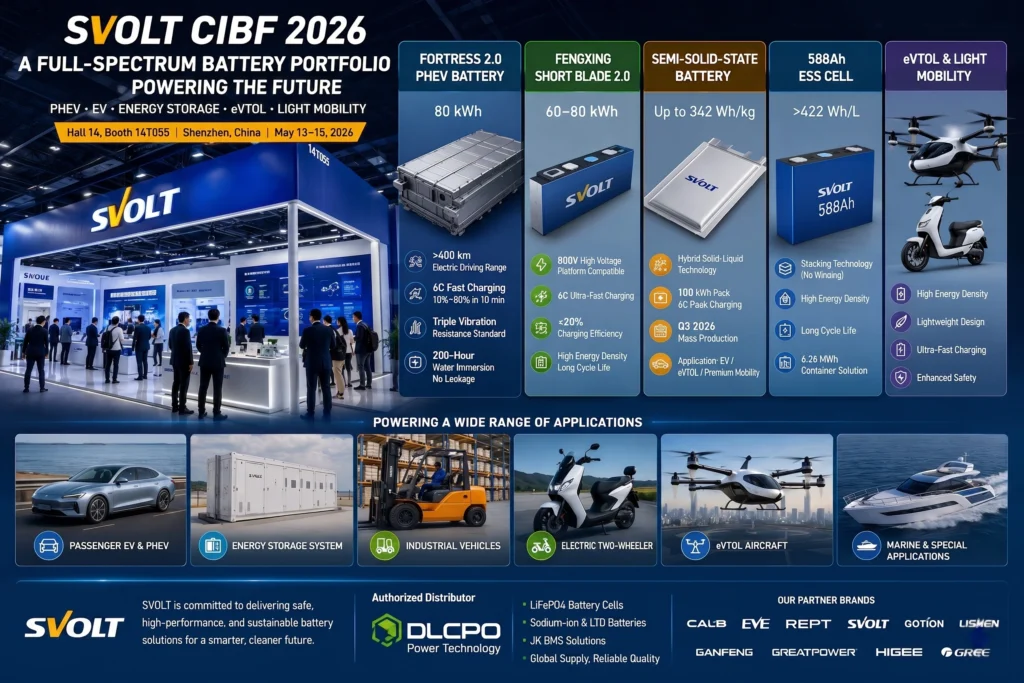

SVOLT CIBF 2026 quickly became one of the most discussed topics at this year’s China International Battery Fair in Shenzhen. Inside Hall 14 of the Shenzhen World Exhibition & Convention Center, the company’s booth remained crowded throughout the exhibition as battery distributors, EV manufacturers, energy storage developers, and industrial procurement teams gathered to examine the latest technologies on display.
A few years ago, many of the products presented at battery exhibitions still felt experimental or far from commercialization. At CIBF 2026, the atmosphere was noticeably different. Discussions focused less on concepts and more on production timelines, charging efficiency, cycle-life stability, and large-scale deployment capability.
That shift says a lot about the current stage of the global battery industry.
SVOLT used this year’s exhibition to present a complete battery technology portfolio covering:
- Fortress 2.0 PHEV battery systems
- Fengxing short blade LiFePO4 batteries
- Semi-solid-state battery packs
- 588Ah utility-scale ESS cells
- eVTOL and lightweight mobility batteries
More importantly, several of these technologies are already entering mass production or moving very close to commercial rollout.
For industrial buyers and battery wholesalers, that distinction matters far more than concept demonstrations.
SVOLT Fortress 2.0 Battery at CIBF 2026
Fortress 2.0 is SVOLT’s latest high-capacity PHEV battery platform designed for ultra-fast charging and extended electric driving range.
Among all products displayed during CIBF 2026, this battery pack generated some of the strongest industry attention.
Configured at 80 kWh, Fortress 2.0 is currently positioned as one of the world’s largest-capacity mass-produced PHEV battery systems. According to information presented during the exhibition, the platform can support over 400 km of electric driving range under certain configurations — a figure that significantly changes how plug-in hybrid systems are viewed.
Traditionally, PHEV batteries were designed primarily for short urban commuting. Fortress 2.0 pushes much closer to full EV operating capability while still retaining fuel-based backup flexibility.
For fleet operators and commercial users, this solves a practical problem.
In many overseas markets, charging infrastructure remains uneven outside major cities. Long-distance logistics fleets, industrial vehicles, and commercial operators often require a balance between electrification goals and operational reliability. A large-capacity PHEV platform offers an effective transitional solution.
Charging performance also became a major discussion point at the SVOLT booth.
The system supports peak 6C fast charging, allowing charging from 10% to 80% in approximately 10 minutes under optimized conditions. However, what impressed many procurement teams was not only charging speed, but the supporting safety structure behind it.
SVOLT highlighted:
- Triple-standard vibration resistance
- Enhanced side-impact protection
- 200-hour water immersion sealing capability
- Improved thermal management performance
During conversations with overseas buyers at CIBF 2026, many procurement teams focused less on headline energy density figures and more on long-term supply stability, thermal consistency, and charging durability under real operating conditions. That trend appeared repeatedly across the exhibition floor.
SVOLT Short Blade LiFePO4 Batteries and the Growth of Fast Charging
SVOLT’s Fengxing Short Blade Battery platform became another major highlight at CIBF 2026.
Short blade batteries are increasingly important because they improve:
- Space utilization efficiency
- Structural stability
- Heat dissipation consistency
- Fast-charging capability
The second-generation Fengxing platform supports:
- 800V high-voltage systems
- 6C ultra-fast charging
- Improved charging efficiency
- Higher pack integration performance
SVOLT also introduced its Ion Oscillation Pulse charging technology, which reportedly improves charging efficiency by approximately 20% without significantly increasing manufacturing cost.
That detail matters because fast charging alone is no longer enough. Manufacturers now face pressure to achieve high charging performance while maintaining:
- Long cycle life
- Stable thermal behavior
- Commercial scalability
- Cost competitiveness
As 800V EV architectures continue expanding globally, high-rate LiFePO4 cells are expected to see significantly stronger demand in:
- Commercial EV platforms
- AGV systems
- Forklift fleets
- Hybrid industrial equipment
- Mobile energy storage systems
At DLCPO Power Technology, we have observed similar changes among overseas industrial customers. Many buyers who previously focused mainly on battery capacity and pricing are now paying closer attention to charging efficiency, thermal consistency, and long-term supply reliability.
Customers looking for industrial-grade lithium battery products can explore our industrial LiFePO4 battery cell solutions, including products from SVOLT, CALB, EVE, REPT, GOTION, LISHEN, and other leading manufacturers.
SVOLT Semi-Solid-State Battery Technology Moves Closer to Production
Semi-solid-state batteries became one of the most discussed technologies at CIBF 2026.
Unlike fully solid-state systems that still face large-scale manufacturing challenges, semi-solid-state batteries are increasingly viewed as a realistic transitional technology capable of improving energy density while maintaining practical commercialization potential.
SVOLT confirmed during the exhibition that its hybrid solid-liquid battery packs are scheduled to enter mass production during Q3 2026.
The company introduced several battery platforms, including:
- 270 Wh/kg high-nickel systems
- 342 Wh/kg eVTOL battery cells
- Mid-nickel passenger vehicle batteries
- 100 kWh battery packs supporting 6C charging
One reason these announcements attracted strong attention is because some of the aviation-focused battery products have reportedly already entered real-world flight testing.
That represents an important industry shift.
Battery manufacturers are no longer competing only on laboratory energy density numbers. Commercial readiness, safety engineering, thermal stability, and application-specific optimization are becoming equally important competitive factors.
SVOLT 588Ah ESS Battery Technology and Large-Scale Energy Storage
Energy storage remained one of the dominant themes throughout CIBF 2026, and SVOLT’s 588Ah ESS battery cell became one of the exhibition’s most closely watched utility-scale products.
The 588Ah battery cell is designed for large-scale energy storage systems and uses SVOLT’s proprietary stacking process instead of conventional winding structures.
Why is this important?
As battery cells become physically larger, internal stress control becomes increasingly difficult. Traditional winding structures can create stress concentration points at electrode corners, especially in very large-format cells. Stacking structures help improve:
- Structural consistency
- Thermal stability
- Long-cycle durability
- Safety performance
SVOLT also introduced future plans for 866Ah ESS systems targeting nearly 7 MWh container-level energy capacity.
For utility-scale energy storage developers, larger-capacity systems can reduce:
- Container quantity
- Wiring complexity
- Installation footprint
- Balance-of-system costs
This is one reason why demand for high-quality ESS battery cells continues growing rapidly worldwide.
At DLCPO Power Technology, we currently supply battery solutions from SVOLT, CALB, EVE, REPT, GOTION, GANFENG, GREATPOWER, and HIGEE for industrial ESS projects and overseas battery wholesalers.
Emerging Battery Applications Continue Expanding
Another noticeable trend at CIBF 2026 was the rapid diversification of battery applications.
Beyond passenger EVs and large-scale ESS systems, growing demand is now coming from:
- Electric motorcycles
- Marine batteries
- Telecom backup systems
- eVTOL aircraft
- Portable industrial energy systems
These applications require highly specialized battery characteristics such as:
- Ultra-fast charging
- Extreme cycle life
- Low-temperature performance
- Lightweight structures
- Enhanced operational safety
This growing diversification explains why alternative chemistries also received increased attention during the exhibition.
At DLCPO Power Technology, we have seen rising international demand for both sodium-ion batteries and lithium titanate batteries in applications where traditional LiFePO4 systems may not always be the optimal solution.
Customers exploring alternative battery technologies can also review our:
What Global Buyers Can Learn From SVOLT CIBF 2026
Looking beyond individual product launches, SVOLT’s CIBF 2026 strategy reflects several broader trends shaping the global battery industry.
The market is no longer moving toward a single dominant battery chemistry.
Instead, applications are becoming increasingly specialized:
- LiFePO4 for ESS and cost-effective EVs
- Semi-solid-state systems for premium mobility
- LTO batteries for ultra-fast charging and long cycle life
- Sodium-ion batteries for cost-sensitive markets
- High-rate battery systems for industrial equipment
For procurement teams, battery sourcing decisions are becoming more strategic than ever before.
Price remains important, but buyers are increasingly evaluating:
- Manufacturing consistency
- Long-term supply capability
- Technical support responsiveness
- Cell quality stability
- Future product roadmap alignment
This is one reason many overseas buyers now prefer suppliers capable of providing multiple major battery brands through a single sourcing channel.
Conclusion
SVOLT’s appearance at CIBF 2026 demonstrated how quickly advanced battery technologies are transitioning from research-stage concepts into commercially deployable products.
From Fortress 2.0 and Fengxing short blade batteries to semi-solid-state systems and 588Ah ESS cells, the company presented technologies closely aligned with today’s market priorities: faster charging, higher safety, improved cycle life, and scalable energy storage capability.
For battery wholesalers, industrial users, and energy storage developers worldwide, these technologies are likely to influence procurement decisions for years to come.
DLCPO Power Technology continues supplying reliable lithium battery solutions from leading manufacturers including SVOLT, CALB, EVE, REPT, GOTION, LISHEN, GANFENG, GREATPOWER, HIGEE, GREE lithium titanate batteries, DLCPO sodium-ion batteries, and JK BMS systems for global industrial customers and energy storage projects.
Frequently Asked Questions
What products did SVOLT showcase at CIBF 2026?
SVOLT presented Fortress 2.0 PHEV batteries, Fengxing short blade LiFePO4 cells, semi-solid-state battery systems, 588Ah ESS battery cells, and eVTOL battery technologies during CIBF 2026 in Shenzhen.
What is the Fortress 2.0 battery?
Fortress 2.0 is SVOLT’s latest high-capacity PHEV battery platform featuring 80 kWh capacity, 6C fast charging, and extended electric driving range designed for next-generation hybrid vehicles.
Why are short blade LiFePO4 batteries becoming more popular?
Short blade batteries improve thermal consistency, structural efficiency, fast-charging capability, and space utilization while maintaining the safety advantages of LiFePO4 chemistry.
Why are 588Ah ESS battery cells important for energy storage projects?
Large-format ESS battery cells can reduce container count, installation complexity, wiring requirements, and overall system costs in utility-scale energy storage projects.
When will SVOLT semi-solid-state batteries enter mass production?
According to information presented during CIBF 2026, SVOLT plans to begin mass production of hybrid solid-liquid semi-solid-state battery packs during Q3 2026.
Does DLCPO Power Technology supply original SVOLT battery cells?
Yes. DLCPO Power Technology supplies SVOLT battery cells alongside products from CALB, EVE, REPT, GOTION, LISHEN, GANFENG, and other leading battery manufacturers for industrial buyers and battery wholesalers worldwide.
Author
DLCPO Power Technology Editorial Team
DLCPO Power Technology specializes in industrial lithium battery supply solutions including LiFePO4 batteries, lithium titanate batteries, sodium-ion batteries, and JK BMS systems for global wholesalers, OEM customers, and energy storage projects.
⚠️ Important Technical Disclaimer
The information provided in this article by DLCPO Power Technology Co., Ltd. is intended for general informational and educational purposes only. While we strive to ensure the accuracy of technical data regarding LiFePO4, LTO, and other battery chemistries, industry standards and product specifications are subject to continuous R&D updates.
Please note that actual battery performance—including cycle life, charging speeds, and thermal stability—is heavily dependent on specific real-world application parameters, environmental conditions, and the proper integration of a Battery Management System (BMS). The data presented does not constitute a binding performance guarantee.
DLCPO assumes no liability for any direct, indirect, or incidental damages arising from the use or misinterpretation of this content. For project-specific engineering advice, official datasheets, and verified Grade-A cell procurement, please contact our technical sales team directly at dlcpo@dlcpo.com.


