
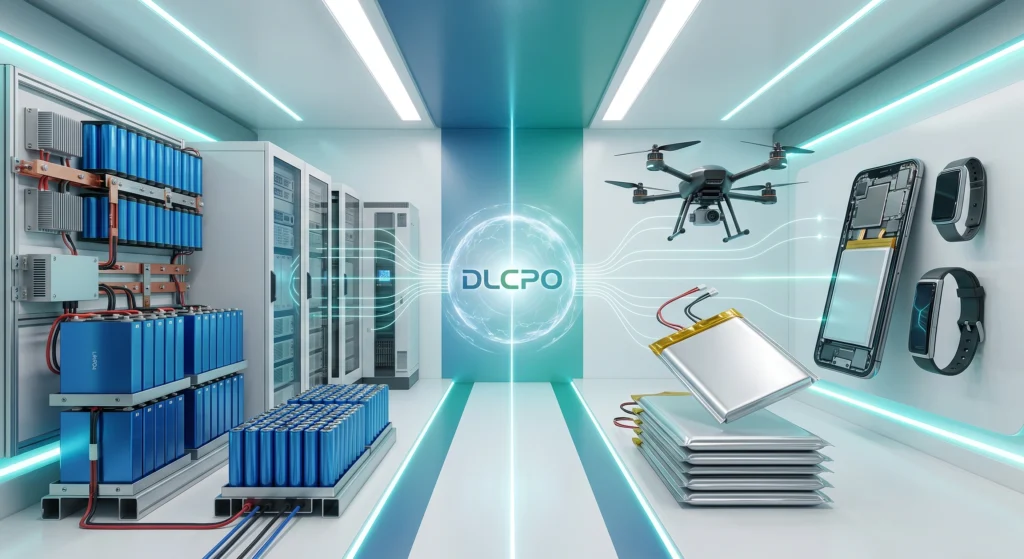
In the global battery procurement landscape, the debate between Lithium-Ion (Li-ion) and Lithium Polymer (LiPo) is often misunderstood. While both rely on the same fundamental lithium chemistry, treating them as interchangeable is a costly mistake.
As an industry veteran dealing with high-capacity LiFePO4 and LTO solutions daily, I’ve seen how the wrong choice can lead to thermal runaway risks, shipping headaches, or premature system failure. Let’s break down what really sets them apart for professional applications.
1. The Core Distinction between Lithium-Ion and Lithium Polymer
The real difference isn’t just “energy”; it’s how the energy is contained.
- Li-ion (The Industrial Workhorse): Uses a liquid electrolyte housed in a rigid metal (usually aluminum or steel) casing. This makes them physically robust and cost-effective.
- LiPo (The Agile Sprint): Replaces the liquid with a gel-like or solid polymer electrolyte, allowing for soft-pouch packaging. This enables the ultra-thin, custom shapes you see in drones and high-end smartphones.
Comparison at a Glance: Industrial Perspective
| Feature | Lithium-Ion (LiFePO4/NCM) | Lithium Polymer (LiPo) |
|---|---|---|
| Physical Form | Rigid (Cylindrical/Prismatic) | Flexible (Pouch/Custom Shapes) |
| Cycle Life | 2,000 to 10,000+ cycles (LFP/LTO) | 300 to 800 cycles |
| Energy Density | High (Especially NCM) | Highest (Per gram) |
| Safety Profile | Excellent (Especially LiFePO4) | High risk of swelling/puncturing |
| Manufacturing Cost | Mature, low cost/kWh | High (Complexity in manufacturing) |
| TCO (Total Cost) | Low (Due to long life) | High (Requires frequent replacement) |
2. Real-World Performance: Where Theory Meets the Field
When you’re sourcing from suppliers like DLCPO, you’re likely not looking for a phone battery; you’re looking for an energy solution for AGVs, solar storage, or electric mobility.
Safety and Thermal Stability
Safety isn’t just a certification—it’s a logistical reality. Li-ion batteries, specifically the Lithium Iron Phosphate (LiFePO4) variants we specialize in, offer a crystalline structure that is far more stable under high-heat or puncture conditions.
In contrast, LiPo batteries are prone to “puffing” or swelling. For international buyers, this is a nightmare: swollen batteries in a shipment can lead to entire batches being rejected at customs or, worse, thermal incidents during transit.
Cycle Life & ROI
If a procurement team in Germany asks for LiPo for an Energy Storage System (ESS), I immediately advise against it. Why?
- A LiPo battery might fail within a year of heavy daily use.
- A LiFePO4 cell from top-tier brands like EVE, CALB, or GOTION (sourced via dlcpo.com/lifepo4-battery-cells) can easily exceed 4,000 cycles at 80% DOD.
3. Which One Fits Your Business Model?
From my experience in the export market, the choice usually breaks down by region and application:
- The “Consumer” Choice (LiPo): If your project involves slim wearables, racing drones, or medical devices where every gram counts and the product lifecycle is short (1-2 years), LiPo is your winner.
- The “Industrial/Infrastructure” Choice (Li-ion/LFP): If you are building solar farms, electric buses, or warehouse automation, the LiFePO4 or Lithium Titanate (Li4Ti5O12) chemistry is non-negotiable.
Expert Tip: For those operating in extreme climates (Middle East heat or Nordic cold), LiFePO4 and LTO provide a thermal operating window that LiPo simply cannot match without expensive cooling systems.
4. Why Supply Chain Transparency Matters
Navigating the Chinese battery market can be a minefield. Many “A-grade” cells on the market are actually “B-grade” or recycled. At DLCPO, our focus on industrial-grade solutions means we prioritize consistency.
We partner with leaders like REPT, SVOLT, and EVE to ensure that when we talk about 3,500 cycles, your end-users actually get 3,500 cycles.
Explore our latest industrial solutions here:
👉 dlcpo.com/industrial-battery-solutions
Expert FAQ: Quick Hits for Procurement Teams
Q: Is LiPo really “more dangerous” for international shipping?
A: “Dangerous” is a strong word, but they are certainly more sensitive. LiPo pouches are vulnerable to physical impact. For bulk international freight, the rigid casing of Li-ion (LiFePO4) is much easier to certify under UN38.3 standards.
Q: Can I replace my Li-ion cells with LiPo to save weight?
A: Only if you redesign your BMS (Battery Management System). The charging profiles and discharge curves differ. Simply swapping them can lead to overcharging and fire hazards.
Q: Why is LiFePO4 the gold standard for DLCPO?
A: Because it eliminates the “Cobalt anxiety” and offers the safest, longest-lasting chemistry available for today’s energy transition.
Expert Guidance for Your Next Project
Are you weighing the pros and cons of cell types for a high-stakes project? Don’t leave it to guesswork. Contact our technical team at DLCPO today for a consultation on chemistry selection, certification requirements, and global logistics.
⚠️ Technical Disclaimer & Quality Commitment
The information and technical analysis published by DLCPO Power Technology Co., Ltd. are provided for general informational and educational purposes only. While we strive to maintain accurate and up-to-date information regarding LiFePO4, LTO, Sodium-ion, and evolving energy storage technologies, technical specifications, industry standards, and product performance data may be updated without prior notice as technologies continue to evolve.
Performance metrics referenced in this content—including cycle life, charging characteristics, thermal stability, operating temperature range, and energy efficiency—serve as general reference values. Actual real-world performance may vary depending on operating conditions, environmental factors, application design, system integration, and Battery Management System (BMS) configuration. The information presented should not be interpreted as a product warranty, contractual commitment, or guaranteed performance specification.
Our Factory-Direct Commitment: As a dedicated manufacturer and authorized battery integration partner, DLCPO supplies 100% brand-new Grade-A battery cells sourced directly from qualified manufacturing facilities. Combined with professional battery pack engineering and customized BMS solutions, our approach helps customers reduce risks associated with long-term inventory storage, inconsistent cell quality, and system integration challenges while supporting optimal cell freshness and traceability.
For project-specific engineering support, official factory datasheets, battery sourcing inquiries, or customized energy storage solutions, please contact our technical team directly at dlcpo@dlcpo.com or visit our official website dlcpo.com.
Intended Audience & Topics: This content is designed for engineers, battery integrators, OEM/ODM manufacturers, procurement professionals, and energy storage developers seeking reliable technical insights regarding DLCPO battery solutions, LiFePO4 batteries, LTO batteries, Sodium-ion batteries, battery pack design, BMS integration, and energy storage systems (ESS).
Technical insights and data provided by DLCPO Solutions Team.


