
Battery Management System Guide: Core Functions, Architecture & Hardware Design
In this comprehensive Battery Management System guide, we explore why the BMS is the mission-critical “brain” of modern energy storage. At DLCPO, we believe that understanding a Battery Management System guide is essential for ensuring system safety, efficiency, and long-term ROI. Whether you are managing LFP, LTO, or NMC systems, the quality of your BMS determines the success of your project.
Why a Battery Management System Guide Matters More Than Ever
As battery applications expand—from home energy storage to industrial microgrids—the demand for precision management has skyrocketed. A high-quality BMS doesn’t just prevent accidents; it optimizes the return on investment (ROI) by extending cycle life and ensuring every watt-hour is used effectively. For our international partners, a DLCPO-powered system means peace of mind through rigorous engineering and data-driven management.
The Core Functions: A Battery Management System Guide
A robust BMS operates at the center of the energy pack, continuously executing five key functions to maintain system integrity:
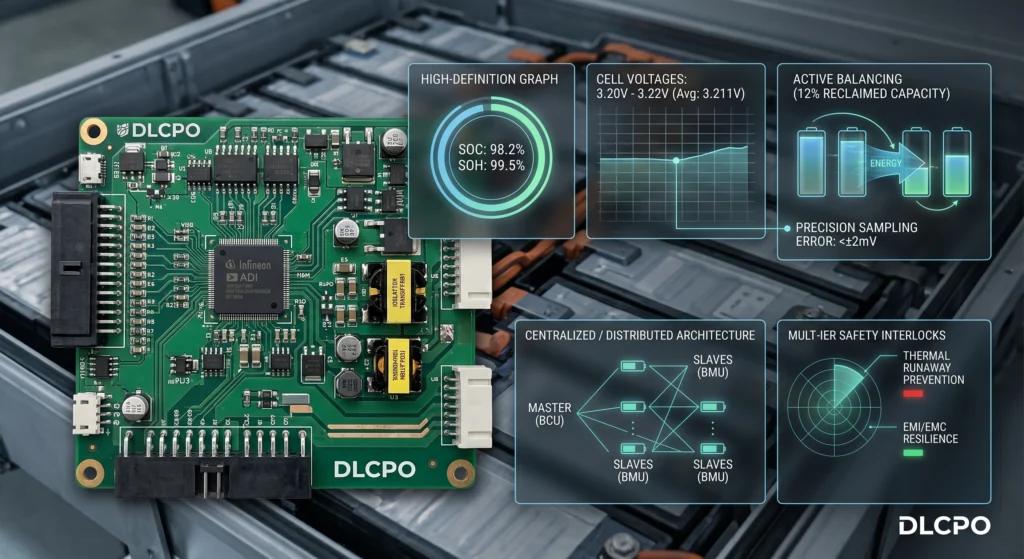
- 1. Real-Time Monitoring: DLCPO systems utilize high-precision sampling to track voltage, current, and temperature at both the cell and pack levels. This granular data is the foundation of all safety protocols.
- 2. Protection Mechanisms: Beyond basic overcharge and over-discharge protection, our BMS manages thermal runaway risks and short-circuit detection, reacting in microseconds to isolate faults.
- 3. Advanced Cell Balancing:
- Passive Balancing: Ideal for cost-sensitive applications, dissipating excess energy via precision resistors.
- Active Balancing: DLCPO’s flagship technology transfers energy between cells, reclaiming up to 12% of usable capacity in large-scale BESS.
- 4. State Estimation (SOC & SOH): Using advanced algorithms like Extended Kalman Filtering, we provide accurate State of Charge (SOC) and State of Health (SOH) data, preventing “jumping” battery percentages.
- 5. Communication Interface: Full support for industrial protocols including CANbus, RS485, and Ethernet, ensuring seamless integration with global inverter brands like Victron, SMA, and Pylontech.
Understanding BMS Architectures: Centralized vs. Distributed
The architecture of a BMS determines its scalability and cost-efficiency. This Battery Management System guide identifies three primary designs provided by DLCPO:
| Architecture | DLCPO Edge | Best Application |
|---|---|---|
| Centralized | Single controller for all cells. Cost-effective and compact. | 12V/24V Starter batteries, E-mobility. |
| Modular (Hybrid) | Master (BCU) and Slave (BMU) setup. Balanced flexibility. | Residential Storage, Forklift batteries. |
| Distributed | Daisy-chained modules. Highly scalable and EMI resistant. | Containerized BESS, Utility-scale projects. |
Hardware Design Considerations for Reliable Performance
At DLCPO, our hardware engineering focuses on the “invisible” details that ensure decade-long stability:
- Precision Sensing: We use automotive-grade sensors to ensure reliable data in extreme temperature environments.
- Thermal Management: Efficient PCB heat dissipation prevents the BMS from overheating during high-current balancing.
- Isolation & Safety: Robust galvanic isolation between high-voltage battery strings and low-voltage control circuits is standard.
- EMI/EMC Control: Optimized PCB layouts ensure zero data loss when operating near high-power inverters.
BMS Trends: The DLCPO Vision
The future of battery management lies in intelligence. DLCPO is currently integrating Cloud-based Diagnostics and AI-driven Predictive Maintenance. By utilizing this Battery Management System guide as a baseline, we allow operators to identify potential failures weeks before they occur, maximizing the second-life value of battery assets.
FAQ: Common Questions About BMS
1. What is the main purpose of a BMS?
A BMS ensures battery safety, monitors performance, and extends battery life by managing charging, discharging, and the overall state of the battery pack.
2. Is a BMS necessary for LiFePO4 (LFP) batteries?
Yes. Although LFP is safer, a BMS is essential to manage its flat discharge curve and protect against over-voltage and cell imbalance.
3. What is the difference between active and passive balancing?
Passive balancing dissipates excess energy as heat, while DLCPO’s active balancing redistributes energy between cells, improving overall efficiency and usable capacity.
4. How do I choose the right BMS for my application?
Consider your system voltage, peak current, and communication needs. For residential storage, a modular Master-Slave system is often the best choice.
5. Can DLCPO provide BMS compatible with 3rd-party inverters?
Yes. Our systems are pre-programmed with protocols for major brands like Victron, Pylontech, and SMA to ensure seamless integration.
Ready to Build a Smarter Battery System?
Empower your energy storage projects with DLCPO’s industry-leading BMS technology. Download our full Battery Management System guide or contact our team.


