
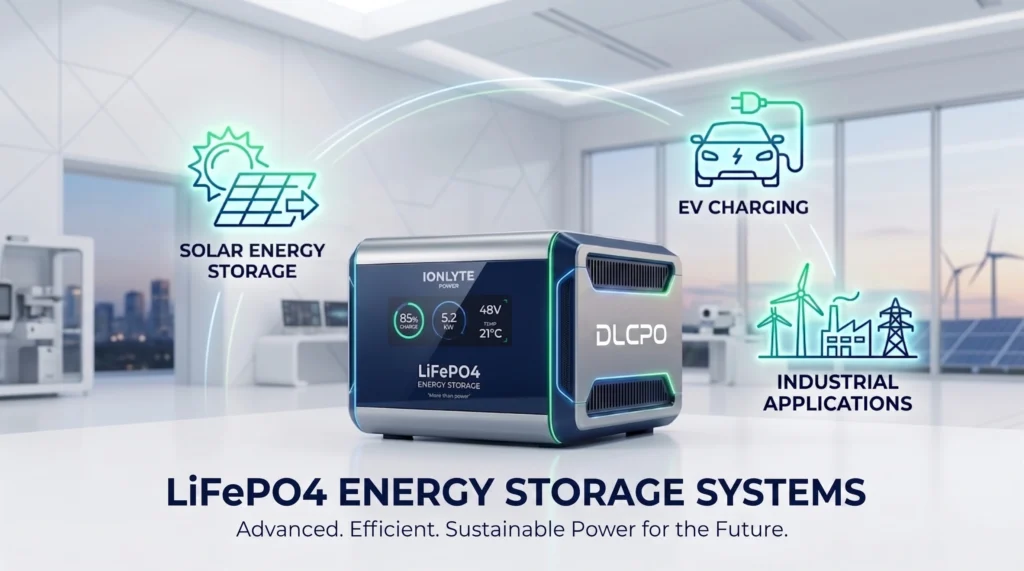
Understanding LiFePO4 Technology: The DLCPO Technical Guide
In the evolving landscape of energy storage, Lithium Iron Phosphate (LiFePO4 or LFP) has emerged as the definitive chemistry for industrial and renewable applications. Unlike standard lithium-ion variants, the LFP chemistry is engineered for stability, making it the primary choice for Solar Energy Storage Systems (ESS), AGVs, and heavy-duty industrial equipment where failure is not an option.
At DLCPO, we believe that understanding the chemical foundation of your power source is critical to optimizing system performance. Beyond the basic specs, the true value of an LFP cell lies in its internal consistency and manufacturing freshness.
Core Technical Characteristics
- Nominal Voltage: 3.2V per cell
- Thermal Runaway: 270°C+ (Extremely high safety margin)
- Cycle Durability: 3,000 to 6,000+ cycles (Application dependent)
- Environmental Impact: Cobalt-free and Nickel-free
How LiFePO4 Operates: The Stability Factor
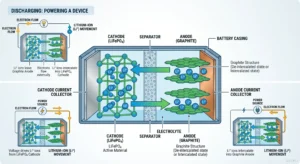
The operational superiority of LiFePO4 comes from its Olivine crystal structure. During the charge and discharge cycles, lithium ions move between the cathode and anode, but the robust P-O (phosphorus-oxygen) covalent bonds ensure the lattice remains intact. This prevents the oxygen release commonly seen in NCM batteries, which is the leading cause of fires and thermal runaway.
Comparative Analysis: Choosing the Right Chemistry
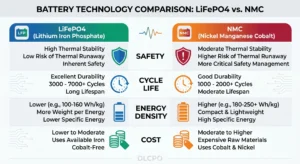
When engineering a battery pack, it is essential to compare LiFePO4 against other lithium-based technologies based on the application’s specific requirements.
| Metrics | DLCPO LiFePO4 | NMC (Ternary) | LTO (Titanate) |
|---|---|---|---|
| Safety Level | Highest Stability | Moderate | Extreme |
| Total Cost of Ownership | Lowest (Long Life) | High | Very High |
| Energy Density | Moderate | High | Low |
Why Professionals Choose LiFePO4
1. Economic Longevity (TCO)
While the initial investment might be higher than lead-acid, the Total Cost of Ownership (TCO) is significantly lower. With cycles often exceeding 10 years of daily use, LiFePO4 is the most cost-effective solution for long-term infrastructure.
2. Thermal and Chemical Resilience
LFP cells maintain structural integrity in high-temperature environments where other lithium chemistries degrade. This makes them ideal for solar ESS in regions with demanding climates.
3. High Discharge Capability
Modern LiFePO4 cells support high C-ratings, which is vital for industrial machinery and AGVs that require rapid bursts of power without compromising the cell’s lifespan.
Industrial Limitations: A Blunt Assessment
No technology is perfect. LiFePO4 has a lower energy density than NMC, meaning the battery packs are typically larger and heavier. For applications where weight is the absolute priority (such as high-performance drones), LFP may not be the optimal fit. However, for stationary storage and heavy transport, the safety-to-weight ratio is unbeatable.
Best Practices for LFP Integration
To ensure your LiFePO4 system operates at peak efficiency, consider the following technical factors:
- BMS Configuration: A high-quality BMS is required to manage cell balancing and voltage thresholds.
- Operating Temperature: While stable, charging LFP below 0°C requires a pre-heating solution.
- Sourcing Strategy: Always prioritize Factory Direct Freshness. Using cells that have sat idle leads to voltage deviation and shortened system life.
Technical Support by DLCPO Power Technology
As a specialist in solar storage and industrial lithium solutions, DLCPO provides customized battery packs and technical consulting. We focus on Factory-Direct production to ensure every cell in your system meets the highest standards of freshness and performance. For technical inquiries or tailored battery designs, contact our engineering team.
⚠️ Important Technical Disclaimer
The information provided in this article by DLCPO Power Technology Co., Ltd. is intended for general informational and educational purposes only. While we strive to ensure the accuracy of technical data regarding LiFePO4, LTO, and other battery chemistries, industry standards and product specifications are subject to continuous R&D updates.
Please note that actual battery performance—including cycle life, charging speeds, and thermal stability—is heavily dependent on specific real-world application parameters, environmental conditions, and the proper integration of a Battery Management System (BMS). The data presented does not constitute a binding performance guarantee.
DLCPO assumes no liability for any direct, indirect, or incidental damages arising from the use or misinterpretation of this content. For project-specific engineering advice, official datasheets, and verified Grade-A cell procurement, please contact our technical sales team directly at dlcpo@dlcpo.com.


