
A few years back, an engineer I know was overseeing the commissioning of a new energy storage container at a facility in Rotterdam. The pack under test had passed every standard certification thrown at it. Yet, during a routine abuse test, a single cell swelled, its skin temperature rocketing past 130°C in under a minute. The automated suppression system kicked in—messy, expensive, and exactly as designed. But the module was a write-off.
“What bothered the engineer most, was not the fire. It was that the barrier material wedged between the cells had softened and given way in roughly twenty seconds.”
That moment reshaped how their procurement team wrote specifications from that day forward. They stopped asking, “Does the pack meet the minimum test requirement?” and started demanding, “What exactly is between our cells, and how long will it hold up when it matters?”
This is the unglamorous reality of PACK manufacturing. Performance specs get all the attention, but it’s the few millimeters of insulation separating prismatic cells that often decide whether a field failure becomes a catastrophic event or a manageable anomaly.
When a Single Cell Turns Unstable—and What Happens Next
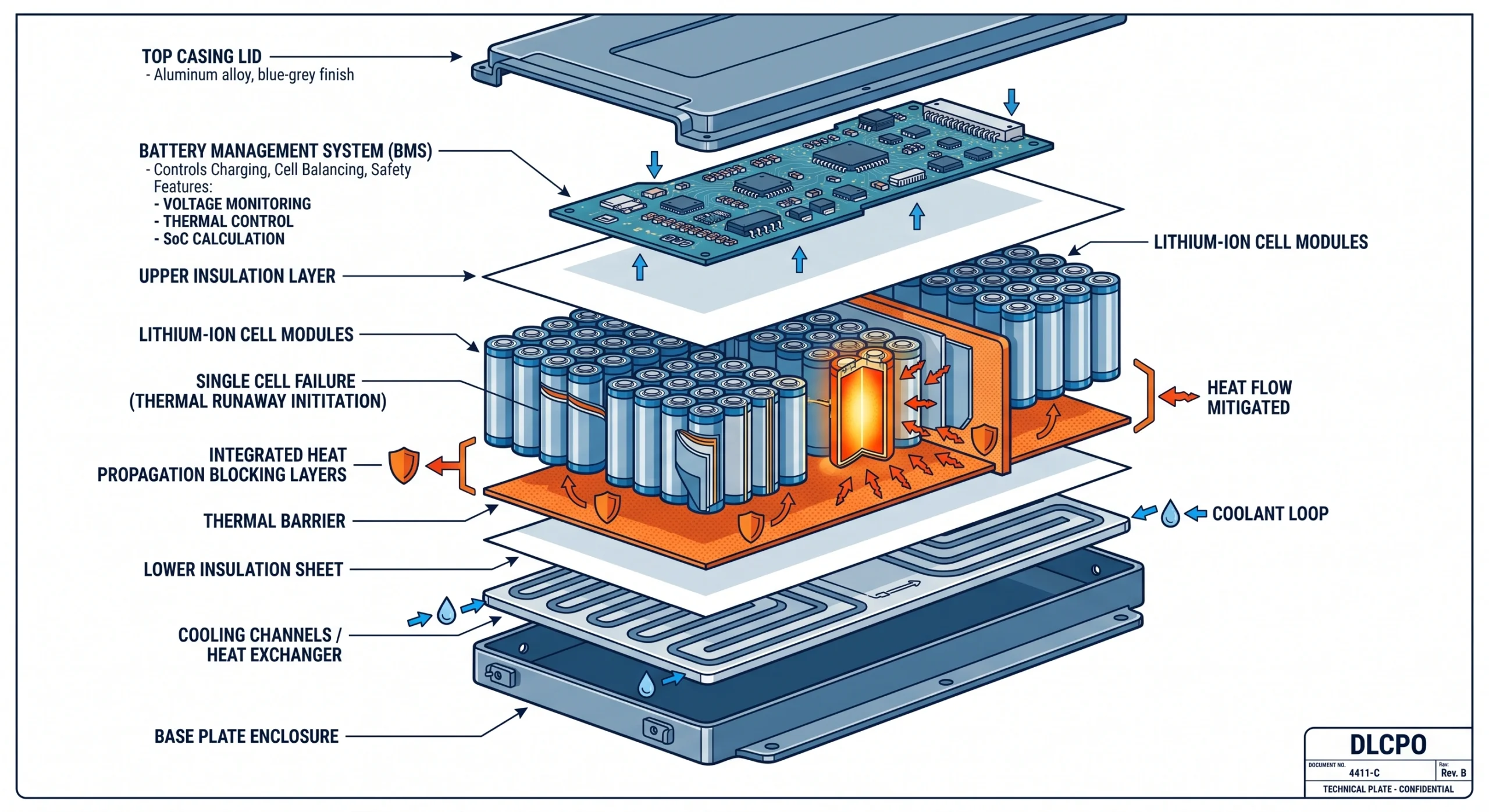
The trouble usually begins quietly, with decomposition of the solid-electrolyte interphase (SEI) layer around 90–120°C. At this stage, you might see trace ethylene and carbon monoxide on a gas analyzer. But that initial exotherm nudges the anode into a reaction with the electrolyte somewhere between 110°C and 150°C, adding hundreds of joules per gram to the thermal budget.
Once the separator collapses and electrodes make direct contact, the internal short drives intense I²R heating in seconds. As experts often observe, once the first cell has gone into thermal runaway, the challenge shifts from prevention to propagation control.
Insulation Inside the Pack—Where Material Choice Shapes Survival
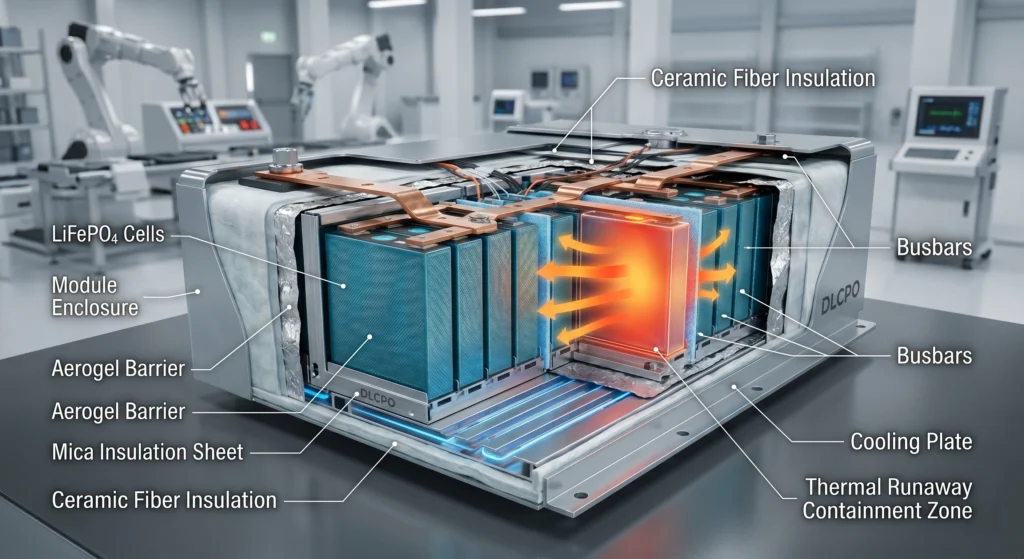
At DLCPO Power Technology, we emphasize that in a densely packed industrial module, the insulation material must block conductive heat transfer while resisting cell “breathing” compression forces.
- Aerogel-based Felts: These have the lowest thermal conductivity (0.015 to 0.025 W·m⁻¹·K⁻¹ at ambient temperature). They are the premium choice for tight cell spacing.
- Ceramic Fiber Boards: Best for temperatures exceeding 1000°C. Ideal for end-plate zones, keeping thermal conductivity in the 0.05–0.12 W·m⁻¹·K⁻¹ range.
- Phase Change Materials (PCMs): These act as thermal buffers by absorbing latent heat during the initial spike.
- Mica Composite Boards: Essential for high-voltage areas due to their superior dielectric strength and integrity up to 800°C.
LiFePO₄ vs. LTO—Chemistry Sets the Stage
While LiFePO₄ offers a wide safety window, Lithium Titanate (LTO)—available through the DLCPO factory direct portfolio—provides an inherently lower risk of thermal runaway thanks to its spinel anode structure. However, even with LTO, DLCPO engineering protocols dictate that thermal propagation must be managed through system-level design, not just chemistry alone.
The DLCPO Advantage: Factory Direct & Product Freshness
We source cells from top-tier manufacturers like CALB, EVE, REPT, and CATL. By maintaining a Factory Direct supply chain, we guarantee Product Freshness—ensuring that the cells in your PACK have not been sitting in secondary warehouses, which preserves the integrity of the internal chemistry and the efficacy of the integrated insulation materials.
How DLCPO Power Technology Approaches Thermal Safety
With manufacturing roots dating to 2007, DLCPO sits at the intersection of cell supply and precision engineering. We integrate intelligent BMS platforms, such as JK BMS, to ensure that thermal data becomes actionable intelligence.
Frequently Asked Questions
Does LiFePO₄ really need insulation if it’s already thermally stable?
Yes. Insulation serves as the safety net that prevents a single-cell event from cascading—an outer layer of defense that chemistry alone cannot provide.
Which insulation material should I choose for tight cell-to-cell gaps?
For clearances under 5mm, Aerogel felt is the most practical choice. For tighter budgets, DLCPO often recommends a hybrid approach using ceramic fiber at module boundaries.
Why choose DLCPO for Factory Direct cell sourcing?
By sourcing directly from EVE, GOTION, and GREE, we provide full traceability and verified abuse-testing data, allowing our engineers to design insulation strategies based on factual cell behavior rather than guesswork.
⚠️ Technical Disclaimer & Quality Commitment
The information and technical analysis published by DLCPO Power Technology Co., Ltd. are provided for general informational and educational purposes only. While we strive to maintain accurate and up-to-date information regarding LiFePO4, LTO, Sodium-ion, and evolving energy storage technologies, technical specifications, industry standards, and product performance data may be updated without prior notice as technologies continue to evolve.
Performance metrics referenced in this content—including cycle life, charging characteristics, thermal stability, operating temperature range, and energy efficiency—serve as general reference values. Actual real-world performance may vary depending on operating conditions, environmental factors, application design, system integration, and Battery Management System (BMS) configuration. The information presented should not be interpreted as a product warranty, contractual commitment, or guaranteed performance specification.
Our Factory-Direct Commitment: As a dedicated manufacturer and authorized battery integration partner, DLCPO supplies 100% brand-new Grade-A battery cells sourced directly from qualified manufacturing facilities. Combined with professional battery pack engineering and customized BMS solutions, our approach helps customers reduce risks associated with long-term inventory storage, inconsistent cell quality, and system integration challenges while supporting optimal cell freshness and traceability.
For project-specific engineering support, official factory datasheets, battery sourcing inquiries, or customized energy storage solutions, please contact our technical team directly at dlcpo@dlcpo.com or visit our official website dlcpo.com.
Intended Audience & Topics: This content is designed for engineers, battery integrators, OEM/ODM manufacturers, procurement professionals, and energy storage developers seeking reliable technical insights regarding DLCPO battery solutions, LiFePO4 batteries, LTO batteries, Sodium-ion batteries, battery pack design, BMS integration, and energy storage systems (ESS).
Technical insights and data provided by DLCPO Solutions Team.


