
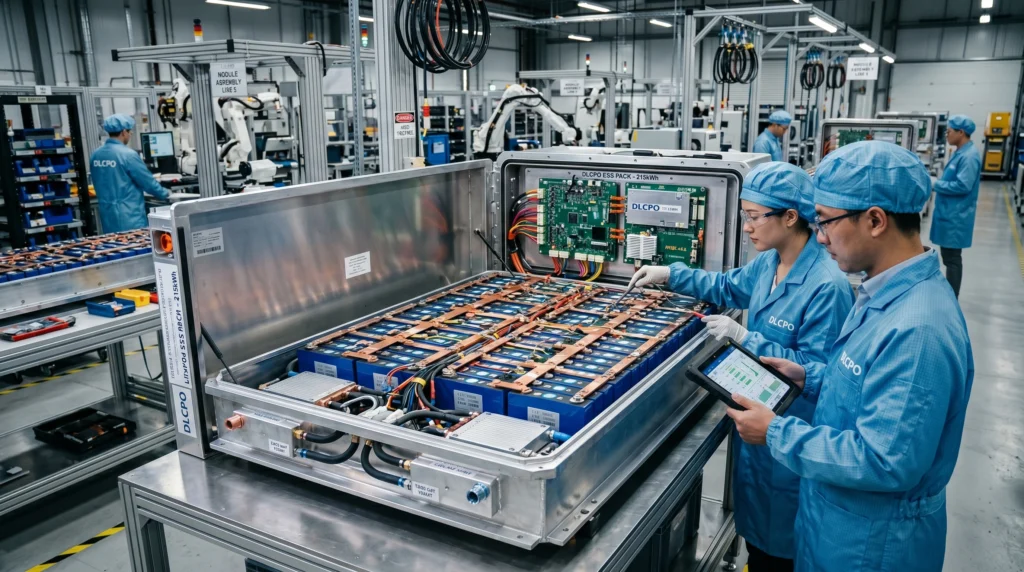
A LiFePO4 battery PACK may look simple from the outside, yet the actual intelligence of the system lives inside the Battery Management System.
Many buyers focus heavily on cell brands, capacity, or cycle life specifications. In real industrial applications, however, long-term reliability depends just as much on PACK engineering, thermal design, communication stability, and BMS integration.
At DLCPO Power Technology Co., we often see projects using the same CALB, EVE, REPT, or SVOLT cells perform very differently after several years of operation. One system remains stable, while another begins showing voltage imbalance, overheating, or communication issues. The difference usually comes from manufacturing quality and BMS design rather than the battery cell alone.
As energy storage projects continue expanding worldwide, the BMS is no longer just a protection board. It has become the operational brain of the entire battery system.
How BMS Integration Protects Your LiFePO4 Battery | DLCPO
Inside a modern LiFePO4 battery system, the BMS continuously monitors voltage, current, temperature, charging behavior, and communication signals. Every charging and discharging decision passes through the BMS.
Industrial customers usually evaluate a BMS based on several practical factors:
- Voltage measurement accuracy
- Cell balancing capability
- Thermal protection response
- Communication stability
- SOC and SOH calculation accuracy
- Compatibility with inverters and ESS platforms
As battery systems become larger and more connected, these functions directly influence safety, maintenance cost, and operational stability.
Core Functions That Influence Battery Lifespan
Cell Voltage Monitoring
Even cells from the same production batch gradually develop small voltage differences during long-term cycling. If these deviations are not controlled properly, battery degradation accelerates.
The BMS monitors each cell individually and immediately activates protection when overcharge or over-discharge conditions appear.
Intelligent Cell Balancing
Cell balancing remains one of the most important functions in PACK manufacturing.
Without balancing, the entire battery pack operates according to the weakest cell. Passive balancing is still common in standard systems because of lower cost, while active balancing is increasingly preferred in large ESS projects where long-term consistency matters more.
JK BMS systems are widely used in industrial LiFePO4 projects because of their strong active balancing performance.
Explore more battery solutions here:
Current and Short-Circuit Protection
Industrial ESS systems, forklifts, AGVs, and telecom backup stations often operate under unstable load conditions.
The BMS continuously monitors charging and discharging current through shunt resistors or Hall sensors. Once abnormal current appears, the protection circuit disconnects the system immediately.
Thermal Management
Temperature control directly affects lithium battery lifespan.
Modern BMS systems integrate multiple NTC sensors across the PACK structure. In larger ESS cabinets, sensors are often positioned near busbars, terminals, and airflow hotspots rather than only near cells.
Field experience shows that uneven heat distribution inside battery cabinets is one of the hidden causes of long-term degradation.
SOC and SOH Estimation
State of Charge (SOC) and State of Health (SOH) calculations help users understand remaining battery capacity and aging conditions.
Accurate estimation requires the BMS to combine voltage tracking, current calculation, temperature compensation, and operating history.
For industrial solar-storage systems, SOC accuracy directly affects energy dispatch efficiency and backup runtime prediction.
System Architecture: One Controller or Distributed Intelligence?
Battery PACK architecture determines communication efficiency, scalability, and maintenance convenience.
Centralized BMS Structure
In centralized systems, all monitoring and protection functions are integrated into one controller board.
This structure works well for smaller battery systems because wiring is simpler and manufacturing cost remains lower.
Distributed BMS Structure
Large industrial ESS systems increasingly use distributed architecture.
Slave boards monitor individual battery modules while a master controller manages communication, SOC calculation, and system-level protection.
CAN bus and RS485 communication protocols are commonly used because they provide stable data transmission for industrial environments.
For containerized ESS projects, distributed BMS structures simplify maintenance and improve scalability.
Under the Enclosure: Hardware Structure That Supports Stability
A reliable battery PACK depends on more than battery cells alone.
Battery Cells
Stable batch consistency, low internal resistance variation, and traceable production standards are critical for long-cycle industrial applications.
DLCPO supplies LiFePO4 battery cells from CALB, EVE, REPT, SVOLT, ETC, ETP, GOTION, LISHEN, GANFENG, GREATPOWER, and HIGEE. We also provide GREE lithium titanate battery cells for ultra-long cycle life and high-rate charging applications.
Learn more here:
Busbars and Conductive Structures
Busbars affect current distribution and thermal stability.
In high-current systems, copper busbars are commonly used for conductivity, while aluminum structures help reduce overall system weight.
Poor welding quality remains one of the most common causes of vibration-related failure in transport and industrial applications.
BMS Control Board
The BMS PCB integrates communication chips, monitoring ICs, balancing circuits, and protection logic.
Industrial-grade BMS boards require stronger EMC resistance and higher environmental reliability compared with consumer battery systems.
Thermal and Structural Design
Battery PACK structures must resist vibration, humidity, dust, and temperature variation.
For outdoor ESS projects, IP protection level, airflow optimization, and corrosion resistance become increasingly important.
Why PACK Manufacturing Quality Matters
As global energy storage demand grows, many battery packs appear similar externally while internal engineering quality differs significantly.
In practical failure analysis, common issues often include:
- Weak cell matching
- Poor insulation protection
- Low-quality connectors
- Unstable communication firmware
- Inadequate thermal management
- Insufficient aging tests
Because of this, industrial buyers increasingly evaluate suppliers based on manufacturing control, BMS integration capability, and long-term technical support rather than cell brands alone.
Where Intelligent Battery PACK Systems Are Heading
Battery PACK systems are becoming more intelligent and software-oriented.
Several trends are already shaping the market:
- AI-assisted battery diagnostics
- Cloud-connected BMS monitoring
- Predictive maintenance
- Wireless communication
- Advanced active balancing
- Higher integration ESS platforms
Industrial users now expect battery systems to provide operational transparency, remote monitoring, and smarter energy management.
Final Thoughts
In modern lithium battery systems, battery cells are only one part of the equation. BMS capability, PACK structure, thermal engineering, and manufacturing quality collectively determine long-term performance.
DLCPO Power Technology Co. focuses on supplying reliable LiFePO4 and lithium titanate battery solutions for global industrial customers. By combining high-quality battery cells with practical PACK integration experience and advanced BMS solutions, we help customers build safer and more stable energy storage systems.
FAQ
1. Why is the BMS important in a LiFePO4 battery PACK?
The BMS protects the battery from overcharge, over-discharge, overheating, and short circuits while also managing balancing, communication, and system stability.
2. What communication protocols are commonly used in industrial BMS systems?
CAN bus and RS485 are widely used because they provide stable communication between battery modules, inverters, and ESS monitoring systems.
3. Why is thermal management critical in energy storage systems?
Uneven temperature distribution accelerates battery aging and reduces system stability. Proper thermal design improves lifespan and operational safety.
4. What is the advantage of active balancing?
Active balancing improves long-term battery consistency by redistributing energy between cells, making it ideal for large-capacity ESS applications.
5. Does DLCPO provide industrial battery solutions?
Yes. DLCPO supplies LiFePO4 battery cells, lithium titanate battery cells, JK BMS systems, and industrial battery solutions for ESS, telecom backup, EV, and solar energy storage projects worldwide.
⚠️ Important Technical Disclaimer
The information provided in this article by DLCPO Power Technology Co., Ltd. is intended for general informational and educational purposes only. While we strive to ensure the accuracy of technical data regarding LiFePO4, LTO, and other battery chemistries, industry standards and product specifications are subject to continuous R&D updates.
Please note that actual battery performance—including cycle life, charging speeds, and thermal stability—is heavily dependent on specific real-world application parameters, environmental conditions, and the proper integration of a Battery Management System (BMS). The data presented does not constitute a binding performance guarantee.
DLCPO assumes no liability for any direct, indirect, or incidental damages arising from the use or misinterpretation of this content. For project-specific engineering advice, official datasheets, and verified Grade-A cell procurement, please contact our technical sales team directly at dlcpo@dlcpo.com.


