
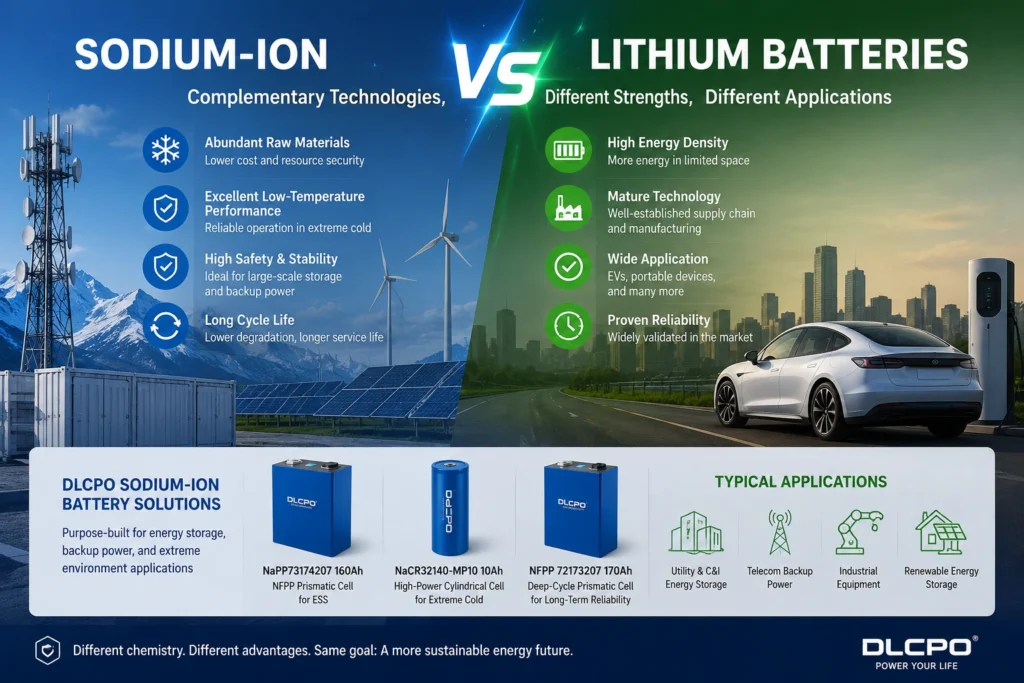
When evaluating Sodium-Ion vs Lithium Batteries, many industrial procurement teams wonder about performance gaps,If you have spent any time in battery sourcing circles over the last eighteen months, you have almost certainly heard the same question repeated across procurement meetings, trade fairs, and inboxes: Is sodium-ion about to kill LFP? It is a compelling, slightly dramatic narrative — one that pits a new, abundant chemistry against the established workhorse of the energy storage world. Yet when we step back and look at the data coming out of our own testing lab and the field feedback from the industrial clients we serve at DLCPO Power Technology, the story softens into something far more practical. Sodium-ion and lithium-ion, especially LiFePO₄, are not locked in a zero-sum fight. They are carving out parallel tracks that, more often than not, end up strengthening each other.
A recent conversation with a telecom tower operator in Southeast Asia crystallised this for us. The client needed a battery that could sit in an uninsulated outdoor cabinet, cycle daily, and shrug off sub-zero winter nights. They had already pencilled in an LFP solution — a safe, proven choice — but the low-temperature performance left them facing a substantial heating system cost. When we suggested pairing the LFP deployment for their high-power sites with our own DLCPO sodium-ion cells for the remote, low-temperature locations, the response was initially hesitation, then curiosity. That dual-chemistry proposal, born out of necessity rather than ideology, is a microcosm of where the market is actually heading.
Why does lithium continue to lead in so many segments? The answer largely comes down to energy density and manufacturing maturity. A typical LiFePO₄ prismatic cell from the manufacturers we distribute — CALB, EVE, REPT and others — comfortably sits in the 160–180 Wh/kg range, with a nominal voltage of 3.2V and a well-oiled global supply chain behind it. For applications where space and weight are at a premium — think passenger EVs, mobile power stations, or marine systems — that density advantage remains decisive. Lithium also benefits from an enormous installed base of compatible inverters and BMS platforms, which means fewer engineering surprises during integration.
Sodium-ion enters the conversation from a different angle entirely. Its calling cards are resource abundance, inherent thermal stability, and a kind of nonchalance about cold weather that makes LFP engineers envious. Because sodium is everywhere and aluminium current collectors can be used on both electrodes, the supply chain dodges many of the lithium carbonate spot-price dramas that have periodically rattled the industry. More importantly, certain sodium-ion chemistries operate comfortably at temperatures where a conventional LFP cell would either refuse to charge or require an expensive heating blanket.
That is not marketing fluff — it is something we have measured repeatedly at our Shenzhen facility. Earlier this year we ran a side-by-side comparison using a 100 Ah LFP cell from a partnered supplier and a sodium-ion cell built on the same chemistry platform as our NAPP73174207 160Ah prismatic cell. At 25°C and 0.5C charge/discharge, the LFP unit delivered around 3,500 cycles to 80% state of health; the sodium unit came in at about 3,000 cycles. Predictable enough. What raised eyebrows was the sodium cell’s behaviour at -20°C. Without any external heating, it maintained 88% of its room-temperature capacity and accepted charge without the lithium-plating anxiety that would turn an unheated LFP cell into a warranty risk. Even our compact NACR32140-MP10 10Ah cylindrical sodium cell — a format we designed with two-wheeler and portable power packs in mind — held its own in the cold, showing negligible capacity fade after repeated sub-zero cycling. One of our engineers remarked offhand that the sodium pack “just didn’t seem to notice the cold.” That kind of field observation sticks with you far longer than a polished spec sheet ever will.
To make the trade-offs easier to digest, the table below distills what we have observed across multiple projects and supplier data sets.
| Parameter | Sodium-Ion (DLCPO) | LiFePO₄ (CALB, EVE, REPT, etc.) |
|---|---|---|
| Gravimetric Energy Density | 120–145 Wh/kg (up to ~160 Wh/kg in advanced variants) | 160–180 Wh/kg |
| Nominal Voltage | 2.9–3.1 V | 3.2 V |
| Cycle Life (25°C, 0.5C to 80% SOH) | 2,800–3,500 cycles | 3,500–4,500 cycles |
| Low-Temperature Performance | Excellent; reliable charging at -20°C without heating | Good, but charging below 0°C requires heating or derating |
| Thermal Stability | Excellent; very low risk of thermal runaway | Excellent |
| Raw Material Supply Risk | Very low (abundant sodium, aluminium current collectors) | Moderate; subject to lithium and copper price volatility |
| Technology Maturity | Emerging, scaling rapidly | Highly mature, massive installed base |
| Representative DLCPO Models | NAPP73174207 160Ah, NACR32140-MP10 10Ah, NFPP-72173207 170Ah | Wide range of LFP cells from CALB, EVE, REPT, SVOLT, GOTION, LISHEN, GREATPOWER, HIGEE |
The cost story, meanwhile, is both genuine and a little more nuanced than headlines suggest. At current production volumes, a sodium-ion cell might undercut an equivalent LFP cell by 15–25% at the cell level. That gap, however, can shrink in a finished pack once you account for the less mature manufacturing ecosystem and — because of sodium’s lower nominal voltage — a slightly higher cell count per string. As gigawatt-hour-scale sodium production comes online, the balance should tip more decisively. For now, the smart money views sodium’s cost edge as a medium-term insurance policy rather than an immediate price disruptor. It echoes the early trajectory of LFP itself: remember, our parent factory has been manufacturing lithium polymer batteries since 2007, and we watched LFP fight for legitimacy against NMC and lead-acid with much the same mix of scepticism and eventual acceptance. That lived experience is precisely why our Shenzhen trading arm, founded in 2024 as DLCPO Power Technology Co., was built from day one to handle multiple battery chemistries under one roof.
Sodium-Ion vs Lithium Batteries: Two Chemistries, One Toolbox
When we map real-world use cases, the dividing line appears organically — and it looks less like a battlefront and more like a division of labour. LiFePO₄ remains the clear choice where energy density, discharge rate flexibility, and broad inverter compatibility matter most: high-power residential storage, commercial UPS banks, and most EV traction applications. Sodium-ion, by contrast, is quietly claiming the territories where LFP struggles or overspends.
Take large-scale stationary storage. The DLCPO NFPP-72173207 170Ah deep-cycle sodium cell was designed for exactly this world — utility-scale solar shifting, industrial microgrids, and telecom backup systems where safety, long-duration cycling, and raw-material sustainability rank higher than squeezing out the last watt-hour per kilogram. The 160Ah NAPP73174207, utilising NFPP (Sodium Iron Pyrophosphate) chemistry, shares that same philosophy and has been qualifying for grid-support projects that expect 15-plus years of daily cycling. At the other end of the size spectrum, the 10Ah NACR32140-MP10 cylindrical cell finds its niche in automated guided vehicles, arctic robotics, and remote monitoring stations — applications where reliable cold-start performance is non-negotiable and an integrated heating loop would be a design burden.
An interesting middle ground is emerging as well. Several of our industrial customers are beginning to blend both chemistries within the same facility — LFP for primary power and high-rate discharge, sodium for cold-climate backup or off-peak shifting — with a unified BMS canopy managing the entire system. We have even tested JK BMS configurations that adapt to mixed-chemistry strings, though it is still early days. The real winner in this landscape is the system integrator or wholesale buyer who can source both chemistries from a single partner, avoiding the headache of juggling multiple suppliers with different support standards. That is, in essence, why our portfolio spans our own DLCPO sodium-ion cells, a broad selection of LiFePO₄ batteries from manufacturers like CALB, EVE, REPT, SVOLT, and even complementary niche chemistries like GREE lithium titanate for ultra-high-cycle applications.
So, will sodium-ion render your LFP stock obsolete? Almost certainly not. The global energy storage market is not a fixed-size pie that forces one chemistry out when another enters. It is an expanding universe of applications, each with its own voltage, temperature, cycling, and budgetary constraints. In that kind of environment, a new, cost-effective, cold-tolerant, deeply sustainable chemistry is not a threat. It is an extra gear in the toolbox — one that we, at DLCPO, are already helping our customers put to work.When we look at Sodium-Ion vs Lithium Batteries, it is clear that both chemistries fill different roles
Frequently Asked Questions
1. Are sodium-ion batteries a direct replacement for LiFePO₄ in existing systems?
Rarely as a drop-in swap. Because sodium-ion cells operate at a lower nominal voltage — our NAPP73174207 160Ah and NFPP-72173207 170Ah models follow the standard sodium curve — a BMS and charger designed for LFP will typically need reconfiguration. We always evaluate this during project consultations at DLCPO, and in most cases, purpose-built sodium systems or hybrid architectures make more sense.
2. What are the main advantages of DLCPO-brand sodium-ion batteries?
Our DLCPO sodium-ion cells — spanning the 10Ah NACR32140-MP10 cylindrical format and the 160Ah/170Ah prismatic formats — deliver dependable low-temperature performance (retaining ~88% capacity at -20°C in our tests), inherent thermal stability that minimises thermal runaway risks, and an aluminium-anode construction that helps stabilise long-cycle life while reducing exposure to raw-material price swings.
3. Can I mix sodium-ion and lithium-ion batteries in the same battery bank?
Not in the same series string — the voltage curves simply do not match well enough for safe balancing. However, running separate strings in parallel at the system level, managed by a master controller, is a feasible and increasingly popular approach for off-grid and C&I storage. Our engineering team can advise on an architecture that safely integrates both chemistries.
4. How does the cycle life of DLCPO sodium cells compare to LFP?
Under standard conditions (25°C, 0.5C charge/discharge), our NFPP-based sodium cells like the NAPP73174207 160Ah typically deliver 2,800–3,500 cycles to 80% state of health, while a quality LFP cell often reaches 3,500–4,500 cycles. The gap narrows substantially in unheated environments, where sodium’s cold-weather charging tolerance can make it the longer-lived option.
5. Does DLCPO supply both sodium-ion and lithium-ion cells for wholesale purchase?
Yes. As a professional battery solution provider, DLCPO Power Technology delivers direct factory supply to guarantee maximum product freshness and optimal cell performance for global wholesalers and industrial users.
Our dual-chemistry supply capabilities include:
-
Factory-Direct Sodium-Ion Cells: We manufacture and supply our own fresh DLCPO sodium batteries, featuring the NAPP73174207 160Ah and NFPP-72173207 170Ah prismatic formats, as well as the NACR32140-MP10 10Ah cylindrical cell.
-
Authorized Premium LiFePO₄ & LTO Integration: As an authorized agent and integrator for top-tier prismatic cell manufacturers, we provide direct factory-fresh distribution from market leaders including CALB, EVE, REPT, SVOLT, GOTION, LISHEN, and GREATPOWER, seamlessly complemented by GREE lithium titanate and JK BMS systems.
⚠️ Technical Disclaimer & Quality Commitment
The information and technical analysis published by DLCPO Power Technology Co., Ltd. are provided for general informational and educational purposes only. While we strive to maintain accurate and up-to-date information regarding LiFePO4, LTO, Sodium-ion, and evolving energy storage technologies, technical specifications, industry standards, and product performance data may be updated without prior notice as technologies continue to evolve.
Performance metrics referenced in this content—including cycle life, charging characteristics, thermal stability, operating temperature range, and energy efficiency—serve as general reference values. Actual real-world performance may vary depending on operating conditions, environmental factors, application design, system integration, and Battery Management System (BMS) configuration. The information presented should not be interpreted as a product warranty, contractual commitment, or guaranteed performance specification.
Our Factory-Direct Commitment: As a dedicated manufacturer and authorized battery integration partner, DLCPO supplies 100% brand-new Grade-A battery cells sourced directly from qualified manufacturing facilities. Combined with professional battery pack engineering and customized BMS solutions, our approach helps customers reduce risks associated with long-term inventory storage, inconsistent cell quality, and system integration challenges while supporting optimal cell freshness and traceability.
For project-specific engineering support, official factory datasheets, battery sourcing inquiries, or customized energy storage solutions, please contact our technical team directly at dlcpo@dlcpo.com or visit our official website dlcpo.com.
Intended Audience & Topics: This content is designed for engineers, battery integrators, OEM/ODM manufacturers, procurement professionals, and energy storage developers seeking reliable technical insights regarding DLCPO battery solutions, LiFePO4 batteries, LTO batteries, Sodium-ion batteries, battery pack design, BMS integration, and energy storage systems (ESS).
Technical insights and data provided by DLCPO Solutions Team.


