
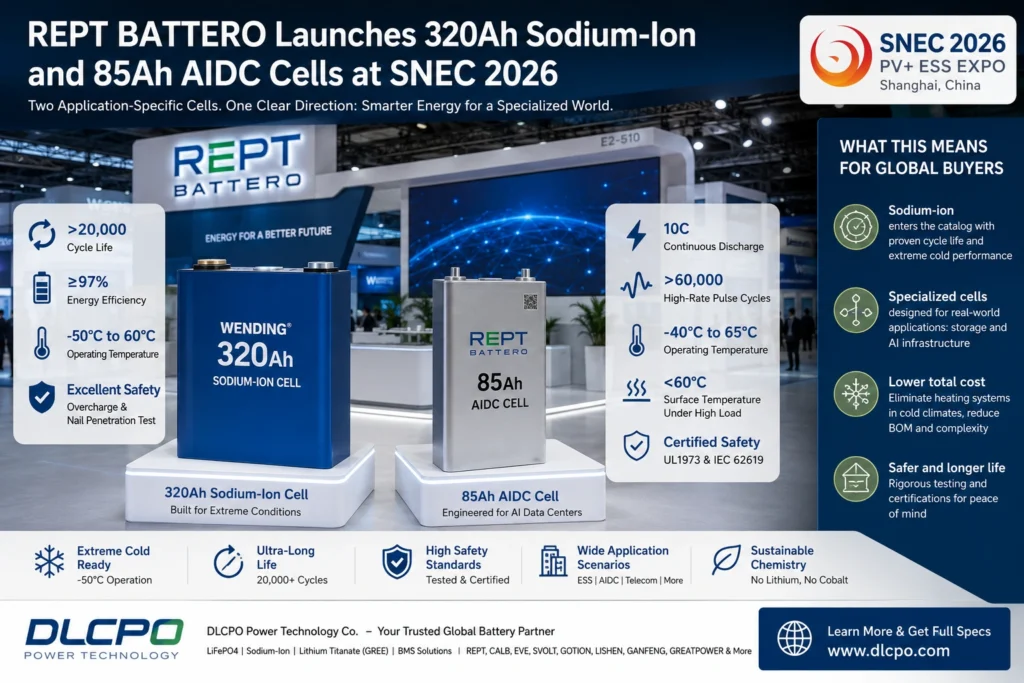

SNEC 2026 made one thing clear the moment you walked the halls: the battery industry has moved decisively from one-size-fits-all lithium toward a landscape of application-specific chemistries. No single booth captured this shift more concretely than REPT BATTERO’s. They didn’t just bring one flagship product—they unveiled two, each laser-focused on a market that’s currently starved for the right cell.
Standing next to the displays with our DLCPO sourcing team, I could tell these weren’t distant prototypes wrapped in protective glass. They were production-intent units, the kind you could imagine palletizing and shipping within a few quarters.
Why Sodium-Ion is Having Its SNEC Moment
Sodium-ion chemistry has hovered on the edge of commercial viability for years, but this SNEC felt like a tipping point. Multiple manufacturers moved beyond lab data to show cells with real warranty terms and mass-production roadmaps. REPT’s contribution—a Wending® 320Ah sodium-ion cell—directly addresses the anxiety many project developers have: that sodium-ion might match LFP on paper but stumble in the field.
The numbers they shared should put some of that anxiety to rest. The cell delivers more than 20,000 cycles, maintains energy efficiency at 97% or above, and operates across a -50°C to 60°C window. If those figures hold in commercial deployment—and REPT had third-party test summaries openly available to back them up—then projects in Scandinavia, Canada, and high-altitude Central Asia could finally shed the parasitic load of battery heating systems. The company claims over 87% capacity retention at -50°C, a figure that historically belonged almost exclusively to expensive lithium titanate chemistries.
For our customers who’ve been hesitating at the edge of sodium-ion adoption, this cell changes the conversation. We’ve already seen a surge in inquiries since the show, and it’s worth mentioning that DLCPO has been steadily building its own sodium-ion product line. Our current in-house offerings range from 10Ah cylindrical cells for distributed applications up to larger-format 160Ah and 170Ah prismatic units for small commercial storage. With REPT now entering the large-format sodium space at 320Ah, industrial buyers gain something rare: a genuine pathway to scale their projects using a single chemistry family, from pilot to full deployment. You can browse our complete sodium-ion range—including both DLCPO-branded cells and partner offerings—on our sodium-ion battery category page.
The 85Ah AIDC Cell: Built for AI, From the Electrode Up
While the 320Ah cell stole headlines, the smaller 85Ah AIDC unit might actually have the more immediate addressable market. It is purpose-built for AI data centers, a segment where conventional backup batteries are showing their limits.
I spent time with the spec sheet because it revealed an engineering philosophy that’s genuinely different from slapping a “data center ready” label on a standard LFP cell. This cell handles continuous 10C discharge, sustains over 60,000 high-rate pulse cycles, and is rated for float service across a -40°C to 65°C range. Crucially, the surface temperature stays below 60°C even under aggressive duty, which solves one of the thermal management headaches that plagues hyper-scale UPS rooms.
Why 85Ah? From talking to REPT’s engineers, the capacity was chosen so that a standard 48V rack-mount module could be assembled with a cell count and voltage window that slot neatly into existing power conversion hardware. No one wants to re-engineer their entire cabinet just to qualify a new battery. The laser-welded aluminum casing also includes an IP-rated vent—a small detail that signals outdoor-rated module compatibility without an extra sealed enclosure, trimming both BOM cost and complexity.
For data center integrators who’ve been battling calendar aging in float service, REPT’s electrolyte additive package seems to directly target that degradation mechanism. I watched a nail-penetration video at the booth; the cell passed without smoke, and the temperature rise curve was remarkably flat. Compliance documentation for UL1973 and IEC 62619 was displayed openly, which isn’t always the case at these shows.
What This Launch Means for Global Buyers
From a procurement perspective, REPT’s dual launch confirms several trends we’ve been tracking at DLCPO. Specialization is accelerating—cells are now designed with the precision that automotive OEMs used to demand, but for stationary and infrastructure markets. Sodium-ion is no longer a “future technology” slide deck; it’s entering the catalog with cycle-life and temperature performance that rival—and in cold climates, exceed—mature LFP chemistries. Safety and longevity remain the core purchasing criteria, and manufacturers are competing on these metrics rather than pure energy density.
This is the kind of diversification that makes a distributor’s role genuinely useful. Our team can now help an industrial buyer compare a REPT 320Ah sodium-ion cell against a CALB LFP cell or a GREE lithium titanate unit, not in theory, but with real data sheets and lead times. We’ve already started compiling pre-order interest, with first samples expected around Q4 2026. If you’re speccing a large-scale storage site or an AI data center backup system, reach out to our team for the complete test summaries and a sample availability timeline. In the meantime, we keep our catalog of mainstream REPT LFP cells—still the volume workhorse for most wholesalers—updated on the REPT Battero brand page.
Looking Ahead
Walking away from SNEC 2026, I felt that the battery industry has crossed an invisible line. The question is no longer whether sodium-ion can compete with LFP in specific niches, but rather how quickly project developers will feel confident enough to specify it. The same goes for data center backup: an 85Ah cell built purely for float service and high-rate pulses is a signal that AI infrastructure is now important enough to warrant its own battery class.
For us at DLCPO Power Technology, that means we can finally offer our customers—from industrial users to LiFePO4 battery wholesalers—a genuine toolkit instead of a single hammer. And that’s a conversation we’re ready to have.
FAQ
1. What is the actual cycle life of the REPT 320Ah sodium-ion cell, and does it degrade faster in hot climates?
REPT specifications state over 20,000 cycles, with third-party test summaries shown at SNEC 2026 supporting this figure. Hot-climate cycling data was partially available; full temperature-range reports will ship with the first commercial batch. We recommend buyers sign up for early access to these reports through our team so you can model degradation accurately for your site conditions.
2. Can the 85Ah AIDC cell be used in standard telecom backup or residential systems, or is it strictly for data centers?
While engineered for AI data center UPS rooms, the cell’s 10C discharge capability and 20-year float life make it technically suitable for telecom backup, medical UPS, and high-end residential systems with aggressive grid independence goals. The main consideration is mechanical integration—the cell form factor was optimized around 48V rack-mount modules. Our engineers can help you check interface compatibility for non-data-center projects.
3. How does DLCPO handle early orders for these new REPT cells, and what is the expected delivery timeline?
We are actively collecting pre-order interest now. First engineering samples are anticipated in Q4 2026, with volume shipments following REPT’s final certification and production ramp milestones. Early commitment secures your place in the allocation queue and ensures you receive updated specs as they’re released.
4. How does REPT’s 320Ah sodium-ion cell compare with Gotion or CALB LFP cells in total cost of ownership?
In cold-climate projects, the sodium-ion cell’s ability to operate below -20°C without heating can eliminate significant balance-of-plant costs, often tipping the TCO equation in its favor even before comparing raw material costs. In moderate climates, LFP still holds a slight upfront Wh price advantage, but sodium-ion’s supply chain avoids lithium and cobalt entirely, offering more predictable long-term pricing. We can provide a side-by-side comparison sheet for your specific project parameters.
5. What brands can DLCPO supply alongside REPT, and do you offer BMS integration support?
We are an authorized distributor for REPT, CALB, EVE, SVOLT, GOTION, LISHEN, GANFENG, GREATPOWER, and others. Our portfolio covers LiFePO4, sodium-ion, and lithium titanate (GREE brand) cells. For pack integration, we work closely with JK BMS and can recommend compatible BMS configurations to get you a tested, field-ready design without starting from scratch.
⚠️ Technical Disclaimer & Quality Commitment
The information and technical analysis published by DLCPO Power Technology Co., Ltd. are provided for general informational and educational purposes only. While we strive to maintain accurate and up-to-date information regarding LiFePO4, LTO, Sodium-ion, and evolving energy storage technologies, technical specifications, industry standards, and product performance data may be updated without prior notice as technologies continue to evolve.
Performance metrics referenced in this content—including cycle life, charging characteristics, thermal stability, operating temperature range, and energy efficiency—serve as general reference values. Actual real-world performance may vary depending on operating conditions, environmental factors, application design, system integration, and Battery Management System (BMS) configuration. The information presented should not be interpreted as a product warranty, contractual commitment, or guaranteed performance specification.
Our Factory-Direct Commitment: As a dedicated manufacturer and authorized battery integration partner, DLCPO supplies 100% brand-new Grade-A battery cells sourced directly from qualified manufacturing facilities. Combined with professional battery pack engineering and customized BMS solutions, our approach helps customers reduce risks associated with long-term inventory storage, inconsistent cell quality, and system integration challenges while supporting optimal cell freshness and traceability.
For project-specific engineering support, official factory datasheets, battery sourcing inquiries, or customized energy storage solutions, please contact our technical team directly at dlcpo@dlcpo.com or visit our official website dlcpo.com.
Intended Audience & Topics: This content is designed for engineers, battery integrators, OEM/ODM manufacturers, procurement professionals, and energy storage developers seeking reliable technical insights regarding DLCPO battery solutions, LiFePO4 batteries, LTO batteries, Sodium-ion batteries, battery pack design, BMS integration, and energy storage systems (ESS).
Technical insights and data provided by DLCPO Solutions Team.


