

Semi-Solid State Battery vs LiFePO4: The Future of Energy Storage | DLCPO
If you’ve been tracking advancements in energy storage battery technology, you’ve likely encountered the growing momentum behind solid-state batteries. However, between conventional lithium-ion systems and fully solid-state designs lies a highly practical innovation: semi-solid state batteries.
This emerging technology is no longer confined to research labs. It is gaining traction among industrial buyers, OEMs, and wholesale battery distributors seeking safer and higher-performance alternatives to traditional LiFePO4 and lithium-ion batteries.
At DLCPO, working with leading manufacturers such as REPT, CALB, LISHEN, and GREE, we closely monitor how semi-solid battery technology addresses real-world performance challenges across energy storage applications.
What Are Semi-Solid State Batteries?
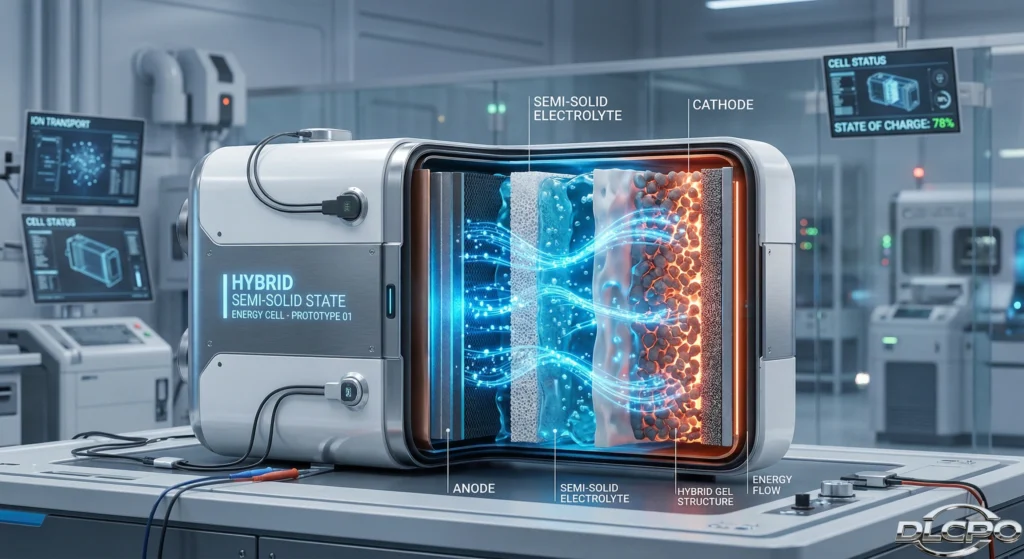
Semi-solid batteries use a gel-like or hybrid electrolyte that combines the advantages of both liquid and solid systems. Compared to traditional lithium-ion batteries:
- Reduced Liquid: They reduce free liquid electrolyte, lowering leakage risks.
- Conductivity: Maintain high ionic conductivity for efficient power delivery.
- Stability: Improve structural and thermal stability under extreme conditions.
From a materials science perspective, semi-solid electrolytes often integrate polymer matrices, ceramic particles, and composite electrolyte systems. This design helps suppress dendrite formation, a key cause of short circuits and battery degradation.
Key Benefits of Semi-Solid Batteries
1. Enhanced Safety Performance
Safety is a top priority in industrial energy storage systems. Semi-solid batteries minimize electrolyte leakage and significantly reduce the risk of thermal runaway, making them particularly suitable for backup power systems, electric mobility, and renewable energy storage.
2. Higher Energy Density
One of the most significant advantages is improved energy density. Semi-solid battery prototypes can deliver 20–30% higher volumetric energy density than standard LiFePO4 batteries, allowing for more power in a smaller footprint.
3. Longer Cycle Life
Due to reduced side reactions and improved electrolyte stability, semi-solid batteries can achieve longer cycle life with lower degradation over time. For industrial users, this directly improves the Total Cost of Ownership (TCO) and ROI.
Semi-Solid vs LiFePO4 Batteries: Comparison Table
| Feature | Semi-Solid Batteries | LiFePO4 Batteries |
|---|---|---|
| Safety | Very High | High |
| Energy Density | Higher | Moderate |
| Cycle Life | Long | Very Long |
| Cost | Higher (Current) | Cost-effective |
| Availability | Emerging | Mature / Widely Used |
Current Applications and Market Trends
Semi-solid batteries are already being adopted in high-end electric vehicles, aerospace systems, and medical devices. As manufacturing scales, DLCPO expects adoption to expand into marine battery systems, telecom backup power, and industrial automation equipment.
Why Choose DLCPO for Your Battery Solutions?
As a professional technical sales team, DLCPO provides an expert perspective on choosing the right chemistry for your needs:
- LiFePO4 batteries: Cost-effective, reliable, and widely adopted.
- Titanium lithium batteries (GREE): For extreme temperature and ultra-long life.
- Semi-solid batteries: The ultimate balance of safety, density, and performance.
We emphasize factory-direct supply and product freshness. Every order is processed to ensure you receive the latest production batches with zero shelf-life compromise.
Conclusion
Semi-solid state batteries represent a significant step forward. They deliver improved safety and higher energy density while remaining closer to commercial viability than fully solid-state batteries. For businesses evaluating next-generation energy storage, this technology is a strategic opportunity.
Frequently Asked Questions (FAQ)
Q1: Are semi-solid batteries better than LiFePO4?
Semi-solid batteries offer higher energy density and improved safety, but LiFePO4 remains more cost-effective for general industrial use today.
Q2: When will semi-solid batteries become widely available?
They are expected to enter broader industrial markets within the next few years as production scales and costs decrease.
Q3: Are semi-solid batteries safer than lithium-ion?
Yes. Their reduced liquid electrolyte significantly lowers the risk of leakage and thermal runaway under stress.
Q4: What industries benefit most from semi-solid batteries?
Key sectors include EVs, renewable energy storage (ESS), aerospace, and critical medical backup systems.
Q5: Are semi-solid batteries the same as solid-state batteries?
No. Semi-solid batteries are a hybrid solution, offering a practical bridge between liquid-based and fully solid-state technologies.
Contact DLCPO today at dlcpo@dlcpo.com for bespoke technical consultations and factory-direct battery solutions.
⚠️ Important Technical Disclaimer
The information provided in this article by DLCPO Power Technology Co., Ltd. is intended for general informational and educational purposes only. While we strive to ensure the accuracy of technical data regarding LiFePO4, LTO, and other battery chemistries, industry standards and product specifications are subject to continuous R&D updates.
Please note that actual battery performance—including cycle life, charging speeds, and thermal stability—is heavily dependent on specific real-world application parameters, environmental conditions, and the proper integration of a Battery Management System (BMS). The data presented does not constitute a binding performance guarantee.
DLCPO assumes no liability for any direct, indirect, or incidental damages arising from the use or misinterpretation of this content. For project-specific engineering advice, official datasheets, and verified Grade-A cell procurement, please contact our technical sales team directly at dlcpo@dlcpo.com.


