
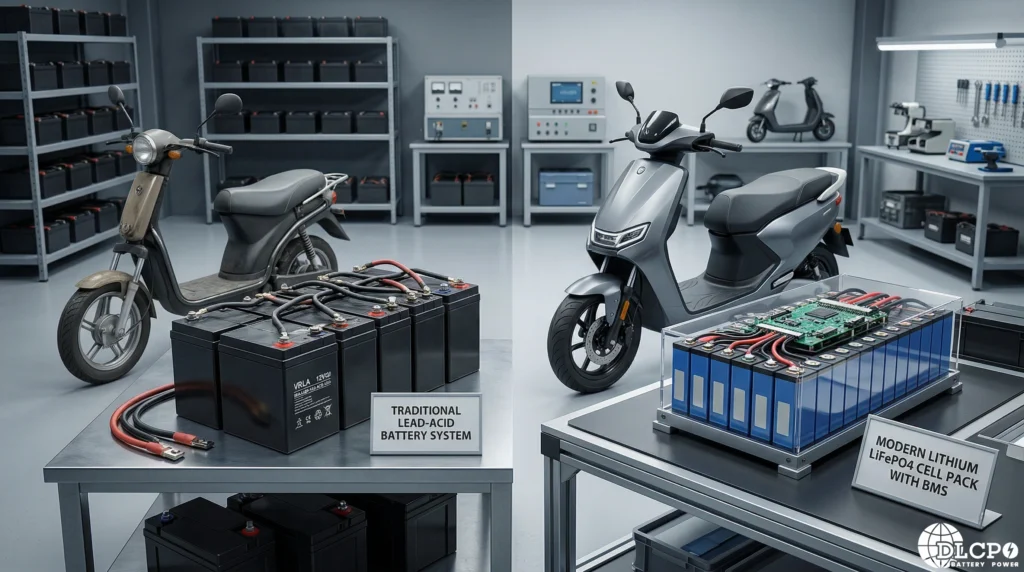

In recent years, the phrase “lithium battery overcapacity” has become almost unavoidable in global energy and B2B supply chain discussions. Massive investments, aggressive expansion by tier-1 cell manufacturers, and fierce price competition have created a widespread impression.
The assumption is that lithium batteries—especially LiFePO4 (LFP)—are globally abundant and increasingly affordable.
Yet, for global battery distributors and light electric vehicle (LEV) manufacturers, a simple market observation raises a complicated question: If there is such a massive lithium battery overcapacity, why do roughly 80% of electric scooters and e-bikes worldwide still rely on traditional lead-acid batteries?
The answer lies not in a single technical factor, but in a complex combination of economics, infrastructure inertia, and specific user behaviors.
The Illusion of Lithium Battery Overcapacity in the Market
At first glance, the narrative of lithium battery overcapacity suggests an excess supply across all application scenarios. In B2B market practice, however, this oversupply is highly unevenly distributed.
Most of the surplus capacity is heavily concentrated in automotive-grade lithium-ion cells, particularly those designed for passenger Electric Vehicles (EVs). These premium cells emphasize ultra-high energy density, extreme cycle life, and strict consistency.
However, these premium features often far exceed the actual requirements of low-speed, cost-sensitive electric vehicles like urban scooters. Meanwhile, emerging markets—especially in Southeast Asia, India, and Africa—operate under entirely different commercial constraints.
Cost Still Dominates the Purchasing Decision
Even as global lithium carbonate prices decline due to lithium battery overcapacity, lead-acid batteries maintain a decisive edge in initial upfront costs. For many end users (like delivery riders) and local dealers, the purchase decision is strictly pragmatic:
- Significantly Lower Initial Price: A lead-acid battery pack can cost 30–50% less than a comparable lithium solution.
- Ease of Replacement: Standardized lead-acid blocks are universally available across local repair shops.
- Cash Flow Sensitivity: For low-income consumers, immediate affordability trumps long-term ROI.
From a Total Cost of Ownership (TCO) perspective, lithium batteries offer vastly superior commercial value. You can explore our LiFePO4 solutions to see how they last 3 to 5 times longer and charge significantly faster.
But lifecycle economics only convert to sales when buyers have the financial flexibility to invest upfront. This gap explains why adoption remains slow in certain sectors.
Infrastructure and Ecosystem Lock-In
Another crucial factor often overlooked by cell manufacturers during this period of lithium battery overcapacity is the power of infrastructure inertia. Lead-acid batteries benefit from decades of deeply rooted systems:
- Mature, highly profitable recycling networks.
- Standardized physical form factors.
- Familiarity and trust among local technicians.
In contrast, lithium battery ecosystems are still fragmented in many developing nations. Integrating lithium reliably requires a highly compatible BMS. At DLCPO, our advanced Battery Management System integrations are specifically designed to bridge this gap, offering standardization that distributors can trust.
Safety Perception and User Trust
Although modern lithium chemistries like LiFePO4 are inherently stable, public perception has not fully caught up with technical reality. News incidents involving poor-quality lithium cells have created caution among both regulators and fleet operators.
Lead-acid batteries, despite being heavy, are viewed as predictable. This trust gap is gradually narrowing as high-quality, perfectly integrated LFP cells gain wider market acceptance.
Application Mismatch: Not Every Scenario Needs Lithium
For a distributor, it’s worth asking: Is lithium always the optimal commercial solution? For ultra-low-speed, short-range applications, the advantages brought by lithium battery overcapacity may simply be commercially overkill:
- Weight reduction is less critical for a vehicle rarely lifted.
- Fast charging is not required if the scooter sits idle overnight.
- A 3000-cycle life may outlast the mechanical frame of the scooter itself.
Where LFP and LTO Batteries are Winning Decisively
Despite the hurdles in the entry-level consumer market, advanced lithium batteries are steadily taking over high-value B2B segments. Markets that prioritize strict TCO are aggressively shifting toward LFP and LTO (Lithium Titanate) solutions:
For instance, DLCPO’s LTO battery product line offers extreme cycle life (up to 20,000+ cycles), ultra-fast charging capabilities, and unparalleled performance in extreme cold temperatures.
Conclusion: A Transition, Not an Overnight Replacement
The persistence of lead-acid batteries in electric scooters is not a contradiction to the global lithium battery overcapacity narrative. Rather, it is a reminder that manufacturing scale and global market realities evolve at different speeds.
For forward-thinking B2B suppliers and regional distributors, the opportunity lies in bridging this transition. At DLCPO, we focus on delivering LiFePO4 and LTO solutions that are both technically superior and economically accessible.
Frequently Asked Questions (FAQ)
1. Is global lithium battery overcapacity real or exaggerated?
It is real, but highly localized to specific segments, particularly EV-grade NMC cells. This surplus does not automatically translate into ready-to-use, cost-effective battery packs for all LEV markets.
2. Why are lead-acid batteries still cheaper than lithium?
Lead-acid batteries utilize simple raw materials, mature manufacturing processes, and highly profitable local recycling ecosystems, keeping their upfront retail costs significantly lower.
3. Are LiFePO4 (LFP) batteries safer than other lithium types?
Yes. LiFePO4 chemistry is globally recognized for its exceptional thermal and chemical stability. When paired with a reliable, high-quality BMS, it is the safest choice for e-mobility.
4. Will lithium ever fully replace lead-acid in electric scooters?
A 100% replacement is unlikely in the short term. However, as local charging infrastructures improve and lithium pack costs continue to optimize, lithium will capture the majority of the mid-to-high-end market.
5. What applications benefit most from LTO (Lithium Titanate) batteries today?
LTO batteries excel in high-intensity commercial scenarios requiring ultra-fast charging, extreme weather tolerance, and an ultra-long lifecycle. They are highly favored in industrial equipment and heavy-duty fleets.
⚠️ Important Technical Disclaimer
The information provided in this article by DLCPO Power Technology Co., Ltd. is intended for general informational and educational purposes only. While we strive to ensure the accuracy of technical data regarding LiFePO4, LTO, and other battery chemistries, industry standards and product specifications are subject to continuous R&D updates.
Please note that actual battery performance—including cycle life, charging speeds, and thermal stability—is heavily dependent on specific real-world application parameters, environmental conditions, and the proper integration of a Battery Management System (BMS). The data presented does not constitute a binding performance guarantee.
DLCPO assumes no liability for any direct, indirect, or incidental damages arising from the use or misinterpretation of this content. For project-specific engineering advice, official datasheets, and verified Grade-A cell procurement, please contact our technical sales team directly at dlcpo@dlcpo.com.


