
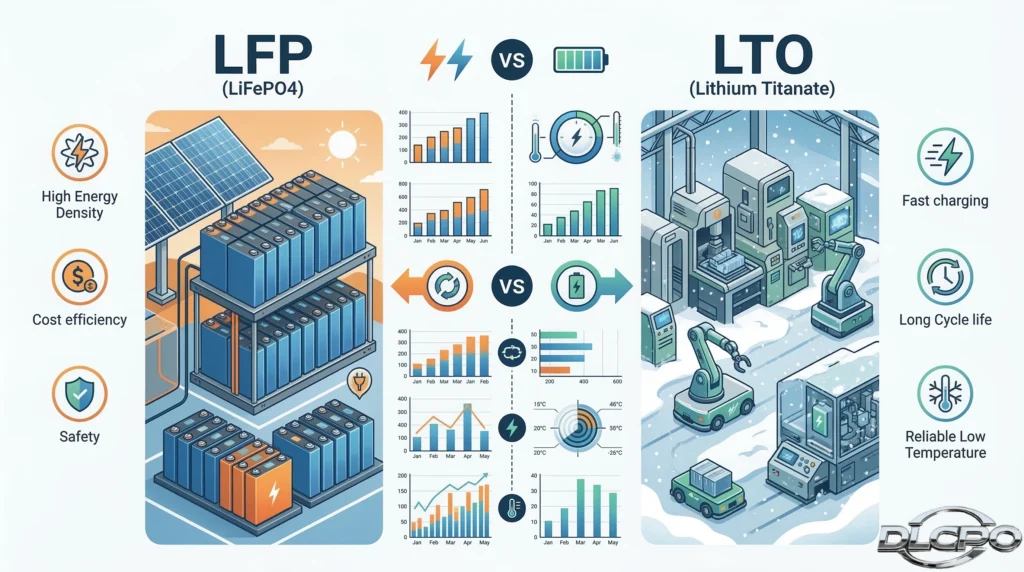
LFP vs LTO: Not a Winner, But the Right Tool for the Job
In industrial energy storage and electrification projects, one question consistently comes up: LFP vs LTO battery—which is the better choice?
From automated port vehicles in Europe to grid frequency regulation systems in North America, to off-grid telecom sites in cold regions like Canada or Northern Europe, the answer is never universal. It depends entirely on how well the battery chemistry matches the operational reality.
After nearly two decades working with lithium battery technologies—including partnerships with Tier-1 manufacturers like SVOLT, EVE, and GREE—I’ve found that the decision between LFP (LiFePO4) and LTO (Lithium Titanate) is not about chasing trends. It’s about evaluating core constraints:
- Temperature constraints
- Charge/discharge behavior
- Total Cost of Ownership (TCO)
The Chemistry of Compromise
Battery selection is not a blind race toward higher energy density. In industrial environments, it is a delicate balance between safety, durability, power capability, and cost.
LFP Battery (LiFePO4)
LFP has become the undisputed industry standard for general Energy Storage Systems (ESS). With an energy density of 140–180 Wh/kg, LFP offers a strong balance between performance and cost, making it the default choice for most projects.
Its advantages include:
- Strong thermal stability (highly resistant to thermal runaway)
- Mature and scalable supply chain
- Competitive cost per kWh
- Reliable cycle life (3,000–6,000 cycles)
Typical applications: Residential & commercial ESS, Solar + storage projects, and Mobile power units.
LTO Battery (Lithium Titanate)
LTO batteries follow a completely different design philosophy. By replacing the standard graphite anode with lithium titanate, LTO sacrifices some energy density to achieve extreme performance metrics.
LTO delivers:
- Extremely fast charging (5C–10C capability)
- Ultra-long cycle life (15,000–25,000 cycles)
- Exceptional low-temperature performance
However, it comes with trade-offs: Lower energy density (70–90 Wh/kg) and a higher upfront cost. This makes LTO less suitable for energy-dense, space-constrained applications, but highly valuable in high-power, high-frequency, or extreme weather environments.
LFP vs LTO Battery: Quick Technical Comparison
| Parameter | LFP Battery (LiFePO4) | LTO Battery (Lithium Titanate) |
|---|---|---|
| Energy Density | 140–180 Wh/kg | 70–90 Wh/kg |
| Cycle Life | 3,000–6,000 cycles | 15,000–25,000 cycles |
| Charging Speed | 0.5C–1C | 5C–10C |
| Low Temp Charging | ≥ 0°C (Requires heating below freezing) | -30°C to -40°C (No heating required) |
| Initial Cost | Lower | Higher |
| Best Use Case | Energy storage, solar integration | High-power industrial, cold climate |
Where the Numbers Lead You
1. Temperature Performance in Real-World Conditions
Physics sets hard limits. LFP batteries cannot be charged below 0°C without risking permanent internal damage (lithium plating). They strictly require integrated heating systems in cold climates. In contrast, LTO batteries can safely charge at -30°C to -40°C and require no pre-heating.
We routinely supply LTO systems to projects in Canada, Northern Europe, and high-altitude regions, where eliminating heating systems significantly improves overall reliability and reduces system complexity.
2. Power Delivery and Fast Charging
In high-throughput industrial environments, charging speed defines operational productivity. LFP is suitable for steady, low-rate cycling, making it ideal for daily charge/discharge routines like solar storage. LTO, however, supports ultra-fast charging (reaching a full charge in just 6–15 minutes) and enables continuous opportunity charging.
LTO Fast-Charge Applications: Automated Guided Vehicles (AGVs), Port machinery (RTG cranes), and Grid frequency regulation. This capability allows expensive equipment to stay operational instead of waiting for long charging cycles.
3. Cycle Life and Total Cost of Ownership (TCO)
While an LFP pack provides 3,000–6,000 cycles (typically a 5–10 years lifespan), an LTO pack offers an astonishing 15,000–25,000+ cycles, often exceeding 20 years of continuous operation. Although LTO has a higher upfront cost, in high-cycle applications (doing multiple cycles per day), its Total Cost of Ownership (TCO) becomes significantly lower than replacing LFP packs multiple times.
4. The Importance of Cell Freshness
Battery performance starts at production. A “fresh” cell ensures maximum chemical activity, longer calendar life, and better pack consistency. At DLCPO, all cells are sourced under a strict no-stock policy. This means no long-term warehouse aging—only direct factory production immediately after your order. This freshness is critical for preserving the lifespan of LFP and maximizing the long-term ROI of LTO.
How Industrial Buyers Choose Between LFP and LTO
Industrial procurement decisions are driven by strict operational constraints—not just spec sheets.
✅ Choose LFP battery if:
- You are building a solar + storage system (ESS).
- Installation space and energy density matter.
- Initial budget is a key project constraint.
⚡ Choose LTO battery if:
- You need ultra-fast charging (<20 minutes).
- Your system operates in extreme cold climates.
- Operational downtime is completely unacceptable.
Making the Final Call
There is no universal winner in the LFP vs LTO battery comparison. LFP is the cost-effective standard for most energy storage applications, while LTO is the performance enabler for extreme, high-demand environments. The correct choice depends entirely on your system’s operational profile.
Get Expert Support for Your Battery Project
Choosing between LFP and LTO is not just a technical decision—it directly impacts your system’s performance, lifespan, and ROI. At DLCPO, we support industrial buyers by supplying fresh Grade A battery cells, providing BMS integration support, and optimizing battery selection for real-world applications.
👉 Contact our engineering team today to discuss your project requirements.
Frequently Asked Questions (FAQ)
1. Which battery type is safer, LFP or LTO?
Both are extremely safe. LFP offers strong thermal stability, while LTO eliminates dendrite formation entirely, making it one of the safest lithium chemistries available on the market.
2. Can LFP batteries be used in cold climates?
Yes, but they require built-in heating systems. LFP cannot be charged below 0°C without sustaining permanent damage, whereas LTO can charge normally at -30°C.
3. What is the main difference between LFP and LTO batteries?
The key difference lies in the anode material. LTO uses lithium titanate instead of the traditional graphite used in LFP, which enables significantly faster charging, longer lifespan, and vastly better low-temperature performance.
4. Is LTO worth the higher cost?
For high-cycle or extreme-environment applications, absolutely. LTO can deliver a much lower lifetime cost (TCO) despite the higher upfront investment because it rarely needs replacement.
5. Which battery is better for industrial applications?
It depends. LFP is ideal for stationary energy storage systems (ESS), while LTO is far superior for high-power motive applications, fast-charging AGVs, or cold-climate deployment.
6. Does DLCPO provide BMS support?
Yes. DLCPO provides full technical support for Battery Management Systems (BMS) tailored specifically to both LFP and LTO chemistries to ensure maximum pack efficiency and safety.
⚠️ Important Technical Disclaimer
The information provided in this article by DLCPO Power Technology Co., Ltd. is intended for general informational and educational purposes only. While we strive to ensure the accuracy of technical data regarding LiFePO4, LTO, and other battery chemistries, industry standards and product specifications are subject to continuous R&D updates.
Please note that actual battery performance—including cycle life, charging speeds, and thermal stability—is heavily dependent on specific real-world application parameters, environmental conditions, and the proper integration of a Battery Management System (BMS). The data presented does not constitute a binding performance guarantee.
DLCPO assumes no liability for any direct, indirect, or incidental damages arising from the use or misinterpretation of this content. For project-specific engineering advice, official datasheets, and verified Grade-A cell procurement, please contact our technical sales team directly at dlcpo@dlcpo.com.