
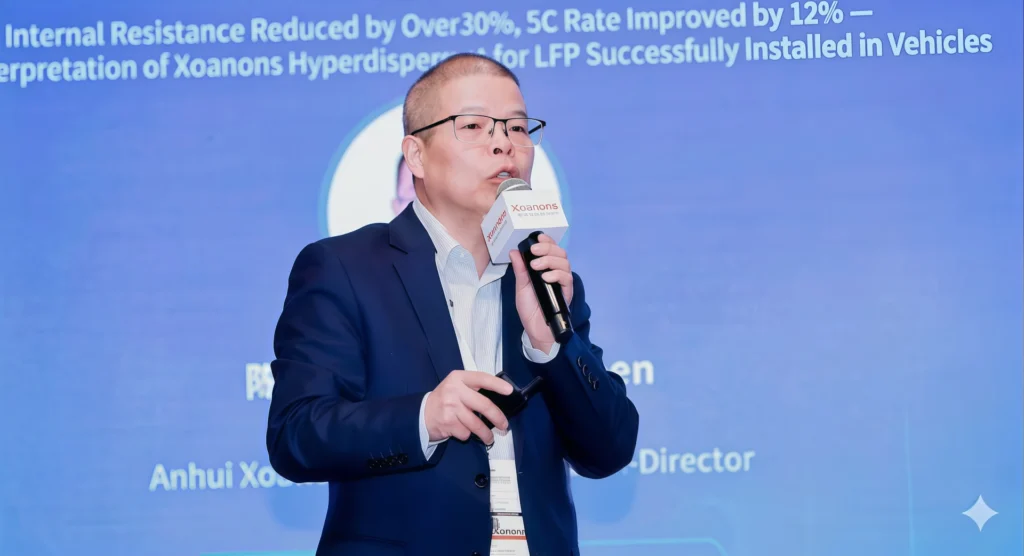

As the demand for LFP Fast Charging continues to surge, the 10th OFweek 2026 in Hong Kong revealed game-changing data,one could feel a palpable shift in the energy storage narrative. While much of the buzz at the 10th OFweek Power Battery Industry Annual Conference focused on raw capacity, the presentation by Chen Yongkang, Chairman of Cenon , hit on a much more practical pain point: how do we make LFP batteries charge as fast as we fuel a petrol car without compromising the cell’s structural integrity?
His keynote, “Data Interpretation of Cenon Super Dispersants Successfully Integrated into LFP Fast-Charging Batteries,” offered more than just laboratory promises; it provided a roadmap for the next generation of high-rate Lithium Iron Phosphate cells.
Beyond the Slurry: Why Dispersion is the New Frontier
For those of us deeply involved in the export and integration of high-performance LFP cells, we know that the “secret sauce” isn’t just the cathode chemistry—it’s the architecture of the slurry. The industry has long struggled with the inherent low conductivity of LFP. To achieve 4C or even 6C charging rates, manufacturers usually pile on conductive agents. However, without proper dispersion, these agents clump, creating “hot spots” that degrade cycle life.
Chairman Chen’s data revealed a fascinating shift. By using “super dispersants,” they’ve managed to create a homogenized network where the conductive carbon is so finely distributed that the internal resistance drops significantly. Why does this matter for a global buyer? It means that the fast-charging LFP batteries we supply are no longer just “experimental” labels; they are reaching a level of stability where the thermal runaway risk during rapid electron influx is effectively mitigated at the molecular level.
From Benchtop to Vehicle: Real-World Data Points
What caught my attention most wasn’t just the chemical formulas, but the confirmation that these dispersed systems have already been successfully “on-boarded” in production vehicles. The data presented showed that LFP batteries utilizing these advanced additives maintain over 80% capacity retention even after rigorous high-rate cycling.
Does this mean LFP is finally closing the gap with LTO (Lithium Titanate) in terms of speed? Not quite—LTO remains the king of extreme cold-weather performance and ultra-long cycles—but it does mean that for mass-market EVs and commercial ESS projects, the cost-to-performance ratio of LFP has just taken a massive leap forward. At DLCPO, we are observing that clients who previously hesitated on LFP for heavy-duty cycling are now reconsidering these “enhanced” LFP configurations for their reliability.
The Strategic Ripple Effect for Global Distributors
As the supply chain matures, the focus is shifting from “how much energy can it hold” to “how quickly can it be ready for use.” The breakthroughs shared in Hong Kong underscore a broader trend: the battery industry is moving away from “brute force” chemistry and toward “precision engineering” of materials.
For our partners at DLCPO, this signals a time to audit your product lineups. Are your current LFP offerings optimized with these high-dispersion technologies, or are you still relying on legacy slurry methods that throttle charging speeds? The gap between a standard LFP cell and a “super-dispersed” fast-charge cell is becoming the primary differentiator in the 2026 market.
Frequently Asked Questions (FAQ)
1. How does “Super Dispersant” technology actually improve LFP charging speeds?
By ensuring that conductive agents are perfectly distributed within the electrode slurry, the dispersant reduces internal resistance and prevents lithium plating during high-rate (4C+) charging. This allows electrons to move more freely, reducing heat generation.
2. Can these fast-charging LFP batteries replace LTO in all applications?
While LFP is catching up in speed, DLCPO’s LTO solutions still hold the advantage for extreme temperatures (down to -50°C) and applications requiring 20,000+ cycles. Enhanced LFP is best for passenger EVs and standard commercial energy storage.
3. Is the technology presented at OFweek 2026 available for commercial export?
Yes. The “successful vehicle integration” mentioned by Chairman Chen indicates that the technology has passed the prototype stage and is now being scaled for mass production, which DLCPO tracks closely for our international clients.
4. Why is DLCPO focusing on the “slurry” chemistry rather than just cell capacity?
Because the slurry consistency determines the safety and longevity of the battery. For foreign buyers, the “total cost of ownership” is lower when using cells with superior dispersion, as they suffer from fewer premature failures.
5. What charging rate can be expected from these new LFP configurations?
Most data suggests a stable 4C charging rate, meaning the battery can reach 80% charge in approximately 15 minutes, provided the charging infrastructure supports high-amperage output.
⚠️ Important Technical Disclaimer
The information provided in this article by DLCPO Power Technology Co., Ltd. is intended for general informational and educational purposes only. While we strive to ensure the accuracy of technical data regarding LiFePO4, LTO, and other battery chemistries, industry standards and product specifications are subject to continuous R&D updates.
Please note that actual battery performance—including cycle life, charging speeds, and thermal stability—is heavily dependent on specific real-world application parameters, environmental conditions, and the proper integration of a Battery Management System (BMS). The data presented does not constitute a binding performance guarantee.
DLCPO assumes no liability for any direct, indirect, or incidental damages arising from the use or misinterpretation of this content. For project-specific engineering advice, official datasheets, and verified Grade-A cell procurement, please contact our technical sales team directly at dlcpo@dlcpo.com.


