
Rethinking “Value” in Energy Storage
For the past decade, the battery industry has been obsessed with cramming more energy into smaller spaces. While that race served the smartphone and EV markets well, it left a massive gap in the industrial sector where longevity trumps lightness. If you are running a solar grid in the Nordics or a heavy-duty hybrid crane, you don’t care if the battery is slightly heavier; you care if it survives the winter.
This is where Lithium Titanate Oxide (LTO) has quietly become the backbone of critical infrastructure. Unlike the fragile graphite anodes found in standard lithium cells—which physically expand and contract until they crack—LTO technology utilizes a spinel-structure nanocrystal surface. It is less like a sponge soaking up water and more like a rigid framework that allows ions to flow freely. The result? A battery that essentially refuses to age.
The GREE LTO Distinction: A Field Perspective
At DLCPO, we have tested countless cell chemistries, but GREE (inheriting the robust legacy of Yinlong technology) occupies a unique position in our portfolio. It’s not just about the raw specifications; it’s about consistent performance under stress.
When we talk about GREE’s LTO advantage, we are really talking about “Zero-Strain” capability. Most batteries have a finite mechanical life, but GREE’s titanium-based anode exhibits almost zero volume change during charging.
Key Benefits of Zero-Strain Technology:
- Lifespan: Exceeding 30,000 cycles.
- Real-world Durability: You could cycle these batteries fully every single day for the next 80 years, and they would likely still be operational.
- Long-term ROI: For projects where battery replacement costs are prohibitive—like remote telecom towers or offshore marine applications—this durability turns a high initial investment into a bargain over the long term.
Explore our GREE LTO Battery Inventory
Performance When the Mercury Drops
One of the most frequent pain points we hear from clients involves temperature management. Standard Lithium Iron Phosphate (LFP) batteries essentially go dormant once temperatures hit freezing, requiring energy-hungry heating pads just to function.
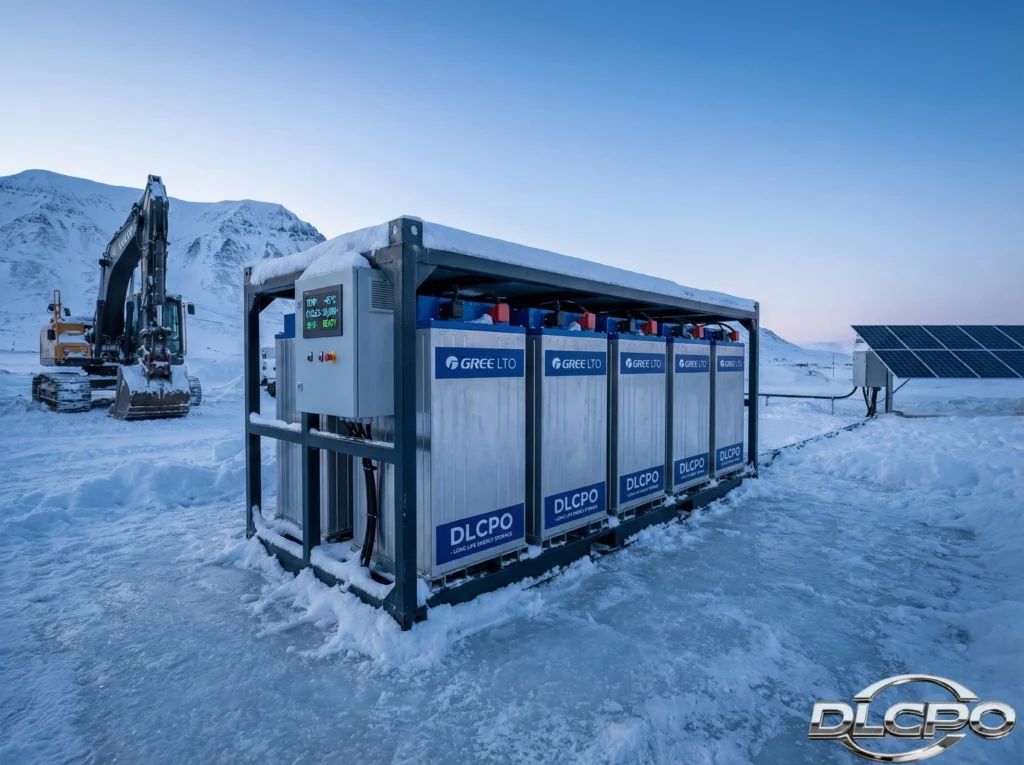
GREE’s LTO chemistry changes this equation entirely. We have observed these cells delivering robust power output even at -30°C (-22°F), with functional discharge continuing down to -50°C. This chemical resilience allows engineers to simplify their system designs, removing complex thermal management systems and reducing failure points. It is a massive advantage for high-altitude or high-latitude deployments where reliability is non-negotiable.
The 2026 Market Landscape: Safety as a Standard
As we move deeper into 2026, safety regulations for energy storage are tightening globally. The inherent safety of LTO is perhaps its most undervalued asset. Because the anode is carbon-free, it eliminates the risk of lithium plating—the primary culprit behind thermal runaway and fires in conventional batteries.
We are seeing a significant shift in the market where GREE LTO cells are being adopted not just for their life cycle, but for their ability to handle high-power pulses (high C-rates) without overheating. Whether it’s absorbing regenerative braking energy from an electric bus or smoothing out wind power fluctuations, these batteries handle current spikes that would cook a standard NMC cell.
Looking Forward
The future of LTO isn’t in consumer electronics; it’s in the heavy lifting of the energy transition. As grid operators and industrial players move from “pilot projects” to permanent installations, the math increasingly favors the “install and forget” nature of Titanate technology. GREE’s continued refinement of this chemistry suggests that while they may never win the energy density war, they have arguably already won the reliability war.
Contact DLCPO for Custom LTO Solutions
FAQ: Understanding LTO Technology
Q: Why are GREE LTO batteries more expensive upfront than LFP?
A: You are paying for the cycle life. While LFP batteries might last 3,000 to 5,000 cycles, GREE LTO cells are rated for 30,000+. When you calculate the “cost per cycle” or the Total Cost of Ownership (TCO) over 10 or 20 years, LTO is often significantly cheaper, especially since you don’t need to replace the pack.
Q: Can I replace my Lead-Acid or AGM batteries directly with LTO?
A: Not directly without checking your equipment. GREE LTO cells have a nominal voltage of 2.3V or 2.4V, which is lower than the 3.2V of LFP cells. You will need a programmable charger and a BMS (Battery Management System) specifically designed for LTO voltage ranges to ensure the system works correctly.
Q: Are these batteries suitable for RVs or Marine house banks?
A: Absolutely, provided you have the space. They are safer and charge much faster than traditional lithium batteries. However, because their energy density is lower, the battery bank will be physically larger and heavier than an equivalent capacity LFP bank. If safety and lifespan are #1, choose LTO.
Q: What does “C-Rate” mean in the context of GREE LTO?
A: C-Rate refers to how fast a battery can discharge. GREE LTO cells are famous for high C-Rates (often 6C continuous or 10C peak). This means a 40Ah battery can safely output hundreds of amps of current instantly, making them perfect for starting engines, thrusters, or heavy hydraulic equipment.
Q: How do I store LTO batteries if I’m not using them?
A: LTO batteries have an incredibly low self-discharge rate. You can store them at a partial state of charge (around 40-60%) in a cool, dry place, and they will retain their voltage for months, if not years, without degradation.
- Chemistry : Original GREE Lithium Titanate Oxide (LTO).
- Cycle Life : 16,000+ cycles (Designed for 30+ years of service).
- Temperature Range : Reliable performance from -50°C to 60°C.
- Charge Speed : Support for 6C-10C ultra-fast charging (Full charge in 10-15 mins).
- Safety : Inherently safe chemistry with zero risk of thermal runaway.
Disclaimer: The content of this article represents personal views and observations based on industry experience. It does not constitute official financial or engineering advice. Please consult with a professional for your specific system requirements.