
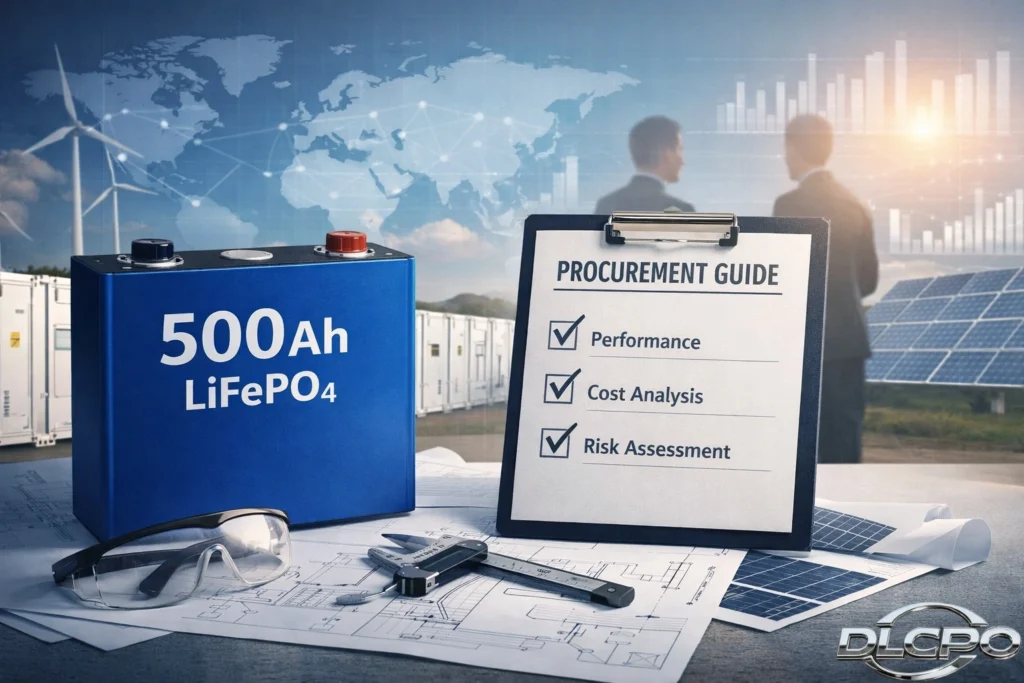
A Procurement-Oriented Guide to High-Capacity LiFePO₄ Battery Sourcing, Performance Evaluation, and Risk Management
1. Purpose and Scope
As global demand for energy storage accelerates, battery procurement decisions are becoming increasingly complex. Beyond chemistry selection, buyers must now evaluate cell format, capacity, system compatibility, and long-term supply stability.
This white paper focuses specifically on 500Ah and higher-capacity LiFePO₄ battery cells produced in China, a segment that has moved rapidly from early adoption to large-scale commercial deployment. The objective is not to promote a specific product, but to provide decision-relevant insights that help procurement teams assess whether 500Ah+ cells align with their technical, economic, and operational requirements.
2.Market Context: Why 500Ah LiFePO4 battery procurement Are Gaining Attention
Historically, energy storage systems relied on smaller-capacity cells connected in large quantities to reach target energy levels. While technically effective, this approach increases system complexity, installation labor, and failure points.
In China, large-scale energy storage projects have driven a shift toward fewer, higher-capacity cells. 500Ah+ LiFePO₄ batteries emerged as a practical response to three procurement pressures:
- Pressure to reduce balance-of-system (BOS) costs
- Pressure to simplify installation and maintenance
- Pressure to improve long-term system reliability
As a result, 500Ah, 560Ah, and similar formats are now widely specified in commercial and utility-scale ESS projects.
3. Manufacturing Maturity and Supply Chain Readiness
One of the primary concerns for procurement teams is whether high-capacity cells can be produced consistently at scale.
Based on current market observations, China’s leading LiFePO₄ manufacturers have reached a level of maturity where:
- Cell-to-cell consistency has improved significantly
- Production yields for large-format cells are stable
- Quality control processes are increasingly standardized
Equally important is upstream integration. Cathode materials, separators, electrolytes, and casing components are largely sourced domestically, reducing dependency risks and lead-time uncertainty. For overseas buyers, this translates into more predictable supply schedules and pricing structures.
4. Technical Considerations for Procurement Evaluation
4.1 Cell Design and Electrical Performance
High-capacity cells are not simple enlargements of smaller formats. Procurement teams should verify that suppliers have redesigned:
- Electrode geometry for uniform current distribution
- Internal resistance management
- Mechanical stability under long-term cycling
Without these optimizations, large cells may exhibit uneven aging or localized heating.
4.2 Thermal Behavior and Safety Margin
Thermal performance becomes more critical as capacity increases. Reputable manufacturers address this through:
- Improved internal heat dissipation paths
- Tighter production tolerances
- Compatibility with external cooling systems
LiFePO₄ chemistry provides an inherent safety advantage, but cell design and manufacturing quality remain decisive factors.
4.3 Cycle Life and Degradation Profile
For procurement decisions, advertised cycle life figures should be evaluated alongside:
- Depth-of-discharge assumptions
- Operating temperature range
- Charge/discharge rate conditions
Large-format cells often deliver better system-level longevity due to reduced interconnection stress, provided manufacturing quality is consistent.
5. Cost Structure: Total Cost of Ownership (TCO) Perspective
From a procurement standpoint, the unit price per cell is only one variable. 500Ah+ cells influence cost in several indirect but significant ways:
- Fewer cells reduce module assembly time
- Lower interconnection count reduces failure risk
- Simplified system layout lowers installation cost
In many projects, these factors contribute more to overall savings than marginal differences in cell pricing.
6. Risks and Challenges Buyers Should Consider
Despite clear advantages, procurement teams should remain aware of potential risks:
- Specification variability: Not all “500Ah” cells perform equally under load
- Certification gaps: International standards for large-format cells are still evolving
- Supplier differentiation: Manufacturing capability varies significantly across suppliers
Due diligence should include factory audits, test data review, and long-term supply commitment assessment.
7. Sourcing Strategy and Supplier Selection
Successful procurement strategies increasingly favor suppliers who offer:
- Transparent technical documentation
- Proven export experience
- Compatibility with established BMS systems
At DLCPO, our role is to bridge Chinese manufacturing capabilities with overseas procurement requirements by supporting LiFePO₄ battery cell sourcing, BMS integration, and export compliance.
Relevant product information is available at:
👉 https://dlcbattery.com/?LiFePO4-Battery-Cells/
8. Strategic Outlook
The adoption of 500Ah+ LiFePO₄ batteries reflects a broader industry trend toward system simplification and lifecycle optimization. While smaller cells will continue to serve certain applications, large-format LiFePO₄ cells are likely to remain central to industrial and utility-scale storage projects.
Procurement teams that understand the technical and commercial implications of this shift will be better positioned to manage risk, control costs, and secure reliable long-term supply.
FREQUENTLY ASKED QUESTIONS (FAQ)
1. Are 500Ah+ LiFePO₄ batteries suitable for all energy storage projects?
They are best suited for industrial and utility-scale systems where system simplicity and lifecycle cost are priorities.
2. What documentation should procurement teams request from suppliers?
Detailed test reports, safety certifications, cycle life data, and consistency metrics are essential.
3. How does supplier selection impact long-term performance?
Manufacturing quality and process control directly affect degradation behavior and system reliability.
4. Can 500Ah cells work with existing BMS platforms?
Yes, provided the BMS is properly configured for voltage, current, and thermal parameters.
5. How should buyers mitigate sourcing risk from China?
Working with experienced exporters and maintaining clear technical specifications reduces uncertainty.
Disclaimer
The analysis and opinions expressed in this white paper are based on industry observation and practical experience and are provided for reference only. They do not constitute technical guarantees or formal procurement recommendations.